Black Friday Reward - Upto 80% off - Ends in 0d 00h 00m 00s - Coupon code: VIP80

Pass the Amazon Web Services AWS Certified Associate DVA-C03 Questions and answers with CertsForce

Viewing page 5 out of 11 pages
Viewing questions 61-75 out of questions
Questions # 61:

A developer works in an environment with multiple AWS accounts that have AWS Lambda functions processing the same 100 KB payloads. The developer wants to centralize the point of origin of the payloads to one account and have all the Lambda functions be invoked whenever the initiating event occurs in the parent account.

How can the developer design the workflow in the MOST efficient way, so all the multi-account Lambda functions get invoked when the event occurs?

Options:

A.

Create a Lambda function in the parent account and use cross-account IAM roles with the AWS STS AssumeRole API call to make AWS Lambda invoke the API call to invoke all the cross-account Lambda functions.


B.

Subscribe all the multi-account Lambda functions to an Amazon SNS topic and make an SNS Publish API call with the payload to the SNS topic.


C.

Set up an Amazon SQS queue with the queue policy permitting the ReceiveMessage action for multi-account Lambda functions. Then send the payload to the SQS queue using the sqs:SendMessage permission and poll the queue using multi-account Lambda functions.


D.

Use a worker on an Amazon EC2 instance to poll for the payload event. Invoke all Lambda functions using the Lambda Invoke API after using cross-account IAM roles with the AWS STS AssumeRole API call.


Expert Solution
Questions # 62:

A company created an application to consume and process data. The application uses Amazon SQS and AWS Lambda functions. The application is currently working as expected, but it occasionally receives several messages that it cannot process properly. The company needs to clear these messages to prevent the queue from becoming blocked. A developer must implement a solution that makes queue processing always operational. The solution must give the company the ability to defer the messages with errors and save these messages for further analysis. What is the MOST operationally efficient solution that meets these requirements?

Options:

A.

Configure Amazon CloudWatch Logs to save the error messages to a separate log stream.


B.

Create a new SQS queue. Set the new queue as a dead-letter queue for the application queue. Configure the Maximum Receives setting.


C.

Change the SQS queue to a FIFO queue. Configure the message retention period to 0 seconds.


D.

Configure an Amazon CloudWatch alarm for Lambda function errors. Publish messages to an Amazon SNS topic to notify administrator users.


Expert Solution
Questions # 63:

A company requires that all applications running on Amazon EC2 use 1AM roles to gam access to AWS services. A developer is modifying an application that currently relies on 1AM user access keys stored in environment variables to access Amazon DynamoDB tables using boto, the AWS SDK for Python.

The developer associated a role with the same permissions as the 1AM user to the EC2 instance, then deleted the 1AM user. When the application was restarted, the AWS

Access Denied Exception messages started appearing in the application logs. The developer was able to use their personal account on the server to run DynamoDB API commands using the AWS CLI.

What is the MOST likely cause of the exception?

Options:

A.

1AM policies might take a few minutes to propagate to resources.


B.

Disabled environment variable credentials are still being used by the application.


C.

The AWS SDK does not support credentials obtained using an instance role.


D.

The instance ' s security group does not allow access to http://169.254.169.254.


Expert Solution
Questions # 64:

A developer is creating a web application. The developer needs to store, retrieve, and rotate database credentials, OAuth tokens, and API keys.

The credentials, OAuth tokens, and API keys must be stored securely as secrets and must not be hardcoded in the application source code. The secrets must be automatically rotated every 6 months.

What should the developer do to meet these requirements?

Options:

A.

Create and store the secrets in AWS KMS. Configure AWS KMS to automatically rotate the secrets every 6 months.


B.

Create and store the secrets in AWS Certificate Manager (ACM). Choose the appropriate certificate type. Set up the rotation period of the certificate to be every 6 months.


C.

Create and store the secrets in Amazon EventBridge. Configure a RotateKey event in EventBridge to rotate the secrets every 6 months.


D.

Create and store the secrets in AWS Secrets Manager. Choose the appropriate secret type. Turn on automatic rotation. Set the rotation schedule to every 6 months.


Expert Solution
Questions # 65:

A team has an Amazon API Gateway REST API that consists of a single resource and a GET method that is backed by an AWS Lambda integration.

A developer makes a change to the Lambda function and deploys the function as a new version. The developer needs to set up a process to test the new version of the function before using the new version in production. The tests must not affect the production REST API.

Which solution will meet these requirements with the LEAST operational overhead?

Options:

A.

Create a new resource in the REST API. Add a GET method to the new resource, and add a Lambda integration to the updated version of the Lambda function. Deploy the new version.


B.

Create a new stage for the REST API. Create a stage variable. Assign the stage variable to the Lambda function. Set the API Gateway integrated Lambda function name to the stage variable. Deploy the new version.


C.

Create a new REST API. Add a resource that has a single GET method that is integrated with the updated version of the Lambda function.


D.

Update the Lambda integration of the existing GET method to point to the updated version of the Lambda function. Deploy the new version.


Expert Solution
Questions # 66:

A developer is deploying a new application to Amazon Elastic Container Service (Amazon ECS). The developer needs to securely store and retrieve different types of variables. These variables include authentication information for a remote API, the URL for the API, and credentials. The authentication information and API URL must be available to all current and future deployed versions of the application across development, testing, and production environments.

How should the developer retrieve the variables with the FEWEST application changes?

Options:

A.

Update the application to retrieve the variables from AWS Systems Manager Parameter Store. Use unique paths in Parameter Store for each variable in each environment. Store the credentials in AWS Secrets Manager in each environment.


B.

Update the application to retrieve the variables from AWS Key Management Service (AWS KMS). Store the API URL and credentials as unique keys for each environment.


C.

Update the application to retrieve the variables from an encrypted file that is stored with the application. Store the API URL and credentials in unique files for each environment.


D.

Update the application to retrieve the variables from each of the deployed environments. Define the authentication information and API URL in the ECS task definition as unique names during the deployment process.


Expert Solution
Questions # 67:

A developer is building an ecommerce application that uses multiple AWS Lambda functions. Each function performs a specific step in a customer order workflow, such as order processing and inventory management.

The developer must ensure that the Lambda functions run in a specific order.

Which solution will meet this requirement with the LEAST operational overhead?

Options:

A.

Configure an Amazon Simple Queue Service (Amazon SQS) queue to contain messages about each step a function must perform. Configure the Lambda functions to run sequentially based on the order of messages in the SQS queue.


B.

Configure an Amazon Simple Notification Service (Amazon SNS) topic to contain notifications about each step a function must perform. Subscribe the Lambda functions to the SNS topic. Use subscription filters based on the step each function must perform.


C.

Configure an AWS Step Functions state machine to invoke the Lambda functions in a specific order.


D.

Configure Amazon EventBridge Scheduler schedules to invoke the Lambda functions in a specific order.


Expert Solution
Questions # 68:

A developer is making changes to a custom application that uses AWS Elastic Beanstalk.

Which solutions will update the Elastic Beanstalk environment with the new application version after the developer completes the changes? (Select TWO.)

Options:

A.

Package the application code into a .zip file. Use the AWS Management Console to upload the .zip file and deploy the packaged application.


B.

Package the application code into a .tar file. Use the AWS Management Console to create a new application version from the .tar file. Update the environment by using the AWS CLI.


C.

Package the application code into a .tar file. Use the AWS Management Console to upload the .tar file and deploy the packaged application.


D.

Package the application code into a .zip file. Use the AWS CLI to create a new application version from the .zip file and to update the environment.


E.

Package the application code into a .zip file. Use the AWS Management Console to create a new application version from the .zip file. Rebuild the environment by using the AWS CLI.


Expert Solution
Questions # 69:

A developer is optimizing an AWS Lambda function and wants to test the changes in production on a small percentage of all traffic. The Lambda function serves requests to a REST API in Amazon API Gateway. The developer needs to deploy their changes and perform a test in production without changing the API Gateway URL.

Which solution will meet these requirements?

Options:

A.

Define a function version for the currently deployed production Lambda function. Update the API Gateway endpoint to reference the new Lambda function version. Upload and publish the optimized Lambda function code. On the production API Gateway stage, define a canary release and set the percentage of traffic to direct to the canary release. Update the API Gateway endpoint to use the $LATEST version of the Lambda function. Publish the API to


B.

Define a function version for the currently deployed production Lambda function. Update the API Gateway endpoint to reference the new Lambda function version. Upload and publish the optimized Lambda function code. Update the API Gateway endpoint to use the $LATEST version of the Lambda function. Deploy a new API Gateway stage.


C.

Define an alias on the $LATEST version of the Lambda function. Update the API Gateway endpoint to reference the new Lambda function alias. Upload and publish the optimized Lambda function code. On the production API Gateway stage, define a canary release and set the percentage of traffic to direct to the canary release. Update the API Gateway endpoint to use the SLAT EST version of the Lambda function. Publish to the canary stage.


D.

Define a function version for the currently deployed production Lambda function. Update the API Gateway endpoint to reference the new Lambda function version. Upload and publish the optimized Lambda function code. Update the API Gateway endpoint to use the $LATEST version of the Lambda function. Deploy the API to the production API Gateway stage.


Expert Solution
Questions # 70:

A developer is writing an application that will retrieve sensitive data from a third-party system. The application will format the data into a PDF file. The PDF file could be more than 1 MB. The application will encrypt the data to disk by using AWS Key Management Service (AWS KMS). The application will decrypt the file when a user requests to download it. The retrieval and formatting portions of the application are complete.

The developer needs to use the GenerateDataKey API to encrypt the PDF file so that the PDF file can be decrypted later. The developer needs to use an AWS KMS symmetric customer managed key for encryption.

Which solutions will meet these requirements?

Options:

A.

Write the encrypted key from the GenerateDataKey API to disk for later use. Use the plaintext key from the GenerateDataKey API and a symmetric encryption algorithm to encrypt the file.


B.

Write the plain text key from the GenerateDataKey API to disk for later use. Use the encrypted key from the GenerateDataKey API and a symmetric encryption algorithm to encrypt the file.


C.

Write the encrypted key from the GenerateDataKey API to disk for later use. Use the plaintext key from the GenerateDataKey API to encrypt the file by using the KMS Encrypt API


D.

Write the plain text key from the GenerateDataKey API to disk for later use. Use the encrypted key from the GenerateDataKey API to encrypt the file by using the KMS Encrypt API


Expert Solution
Questions # 71:

A company ' s developer has deployed an application in AWS by using AWS CloudFormation. The CloudFormation stack includes parameters in AWS Systems Manager Parameter Store that the application uses as configuration settings. The application can modify the parameter values.

When the developer updated the stack to create additional resources with tags, the developer noted that the parameter values were reset and that the values ignored the latest changes made by the application. The developer needs to change the way the company deploys the CloudFormation stack. The developer also needs to avoid resetting the parameter values outside the stack.

Which solution will meet these requirements with the LEAST development effort?

Options:

A.

Modify the CloudFormation stack to set the deletion policy to Retain for the Parameter Store parameters.


B.

Create an Amazon DynamoDB table as a resource in the CloudFormation stack to hold configuration data for the application. Migrate the parameters that the application is modifying from Parameter Store to the DynamoDB table.


C.

Create an Amazon RDS DB instance as a resource in the CloudFormation stack. Create a table in the database for parameter configuration. Migrate the parameters that the application is modifying from Parameter Store to the configuration table.


D.

Modify the CloudFormation stack policy to deny updates on Parameter Store parameters.


Expert Solution
Questions # 72:

A company has installed smart motes in all Its customer locations. The smart meter’s measure power usage at 1minute intervals and send the usage readings to a remote endpoint tot collection. The company needs to create an endpoint that will receive the smart meter readings and store the readings in a database. The company wants to store the location ID and timestamp information.

The company wants to give Is customers low-latency access to their current usage and historical usage on demand The company expects demand to increase significantly. The solution must not impact performance or include downtime write seeing.

When solution will meet these requirements MOST cost-effectively?

Options:

A.

Store the smart meter readings in an Amazon RDS database. Create an index on the location ID and timestamp columns Use the columns to filter on the customers ‘data.


B.

Store the smart motor readings m an Amazon DynamoDB table Croato a composite Key oy using the location ID and timestamp columns. Use the columns to filter on the customers ' data.


C.

Store the smart meter readings in Amazon EastCache for Reds Create a Sorted set key y using the location ID and timestamp columns. Use the columns to filter on the customers’ data.


D.

Store the smart meter readings m Amazon S3 Parton the data by using the location ID and timestamp columns. Use Amazon Athena lo tiler on me customers ' data.


Expert Solution
Questions # 73:

A developer is working on an AWS Lambda function that accesses Amazon DynamoDB. The Lambda function must retrieve an item and update some of its attributes, or create the item if it does not exist. The Lambda function has access to the primary key.

Which IAM permissions should the developer request for the Lambda function to achieve this functionality?

A)

B)

C)

D)

Options:

A.

Option A


B.

Option B


C.

Option C


D.

Option D


Expert Solution
Questions # 74:

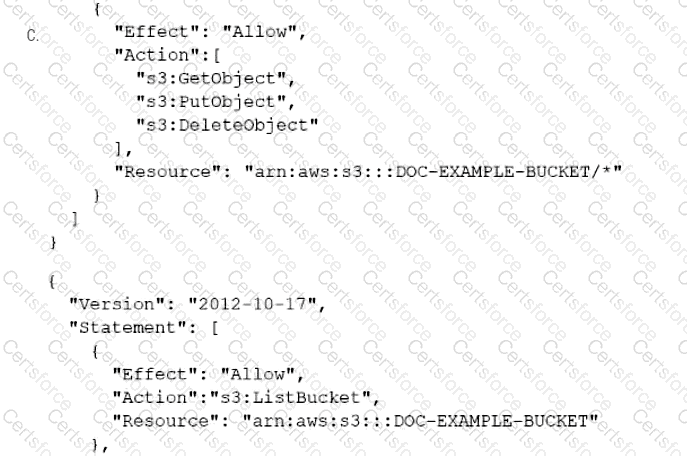
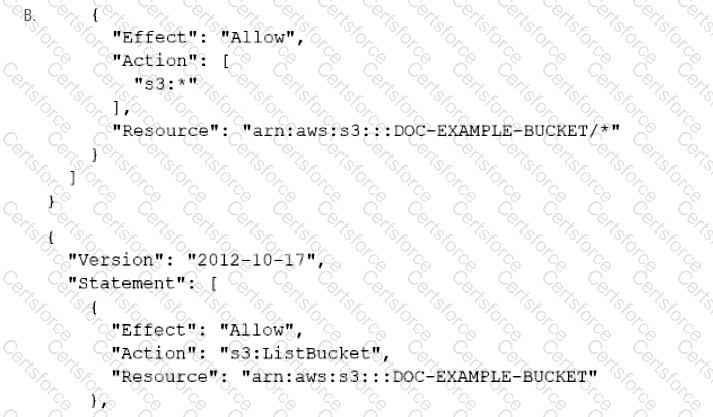
A company has an online web application that includes a product catalog. The catalog is stored in an Amazon S3 bucket that is named DOC-EXAMPLE-BUCKET. The application must be able to list the objects in the S3 bucket and must be able to download objects through an 1AM policy.

Which policy allows MINIMUM access to meet these requirements?
Question # 74

Question # 74

Options:

A.

Option A


B.

Option B


C.

Option C


D.

Option D


Expert Solution
Questions # 75:

A company ' s application uses an Amazon API Gateway REST API and AWS Lambda functions to upload media files to and fetch media files from a standard Amazon S3 Standard bucket. The company runs a nightly job on an Amazon EC2 instance to create dashboards and other visualizations for application users. The job usually runs for 1 to 2 hours.

A developer observes request throttling while the function is running. The application generates multiple 429 exceptions in the Lambda function logs when files do not process successfully. The developer needs to resolve the issue and ensure that all of the application ingests all files.

Which solution will meet these requirements?

Options:

A.

Enable S3 Transfer Acceleration on the bucket. Use the appropriate endpoint.


B.

Call the CreateMultipartUpload API in the Lambda functions to upload the files in pieces.


C.

Implement the retry with a backoff pattern in the Lambda functions.


D.

Set up an S3 Lifecycle policy to automatically move the media files to the S3 Intelligent-Tiering storage class.


Expert Solution
Viewing page 5 out of 11 pages
Viewing questions 61-75 out of questions