
Pre-Summer Special Limited Time 70% Discount Offer - Ends in 0d 00h 00m 00s - Coupon code: force70

Pass the Versa Networks Administrator SD-WAN Specialist VNX301 Questions and answers with CertsForce

Viewing page 1 out of 2 pages
Viewing questions 1-10 out of questions
Questions # 1:

Which two statements are true about templates? (Choose two.)

Options:

A.

You can have more than one device template per appliance.


B.

You must have at least one service template per appliance.


C.

You can use variables in a template to allow devices to have unique values.


D.

You can use a Workflow Template to create new device templates.


Expert Solution
Questions # 2:

Which two statements are true about the differences between a stateful firewall and a next-generation firewall (NGFW) in a Versa solution? (Choose two.)

Options:

A.

Stateful firewalls focus on examining information in L2, L3, and L4 fields, while NGFW can examine all fields of a packet, including L7.


B.

Stateful firewalls can run with any version of VOS, while NGFW requires specific VOS images to operate.


C.

Stateful firewalls cannot log information into Versa Analytics; only NGFW can send logs into Versa Analytics.


D.

Stateful firewalls are available in all of Versa’s licensing offerings, while NGFW requires specific licensing to operate.


Expert Solution
Questions # 3:

You are asked to deploy a Versa Secure SD-WAN branch for 1000 locations. You need to profile the branches based on common deployment requirements.

In this scenario, which three configuration objects would be shared by multiple appliances? (Choose three.)

Options:

A.

device templates


B.

device groups


C.

workflow device


D.

service templates


E.

device bind data


Expert Solution
Questions # 4:

A branch user reports poor throughput over an SD-WAN tunnel. The command show interfaces detail vni-0/0 shows the interface is operating at half-duplex / 100 Mbps , although the circuit is expected to run at 1 Gbps full duplex. What is the most likely cause?

Options:

A.

SD-WAN SLA probing is disabled.


B.

The Controller is not advertising branch routes.


C.

There is an underlay link speed or duplex mismatch.


D.

VXLAN encapsulation is missing on the overlay.


Expert Solution
Questions # 5:

A branch device is powered on with factory-default staging configuration. The device establishes an IKE session to the staging server and receives an IP address, but it does not proceed to establish an IKE session with the Versa Controller. Which staging phase is failing?

Options:

A.

Stage 1


B.

Stage 2


C.

Stage 3


D.

Post-activation template commit


Expert Solution
Questions # 6:

As an administrator, you are migrating your legacy WAN to Versa Secure SD-WAN without changing the underlay network. You need to ensure that, during the migration process, legacy WAN sites are allowed to communicate with SD-WAN branches. Which two steps should be implemented to accomplish this task? (Choose two.)

Options:

A.

Apply the Spoke-to-Spoke-Direct topology for the SD-WAN branches.


B.

Using workflows, configure the Gateway option in the hub template for the underlay links.


C.

Configure BGP on the hub underlay links to advertise and receive the prefixes.


D.

Configure an SD-WAN traffic steering policy to advertise the SD-WAN routes.


Expert Solution
Questions # 7:

A tenant has two internet circuits and one LTE backup circuit. The forwarding profile lists the internet circuits with priority 1 and LTE with priority 2. The next-hop selection method is Load Balance. What is the expected behavior while both internet circuits are healthy?

Options:

A.

Sessions are distributed across the two priority-1 internet circuits.


B.

All sessions are forced to LTE because it has the highest number.


C.

Traffic is replicated across all three circuits.


D.

The branch drops traffic until one circuit fails.


Expert Solution
Questions # 8:

You are configuring a CGNAT rule for branch internet access and want to verify which access-list entry will match traffic before translation. Which information is shown by the CGNAT ACL command?

Options:

A.

Rule ID, category, precedence, VRF, source IP, and destination IP


B.

Only system uptime and CPU usage


C.

Only SD-WAN SLA latency, jitter, and loss


D.

Only BGP AS path and local preference


Expert Solution
Questions # 9:

A branch has Direct Internet Access enabled. Users can resolve DNS, but application traffic fails. You find that the internet speed test also fails to fetch the server list. Which two configurations should be checked first?

Options:

A.

CGNAT and DNS configuration


B.

OSPF area ID and BGP MED


C.

SNMP community and syslog server


D.

VRRP priority and DHCP lease time


Expert Solution
Questions # 10:

Examine the exhibit below.

An SD-WAN administrator has configured Direct Internet Access (DIA) for INET and INET-2 and wants to use SaaS Application Monitoring and SD-WAN policies to steer certain applications to the best Internet path on a certain VOS device.

Which two statements are true regarding the configuration shown in the exhibit? (Choose two.)
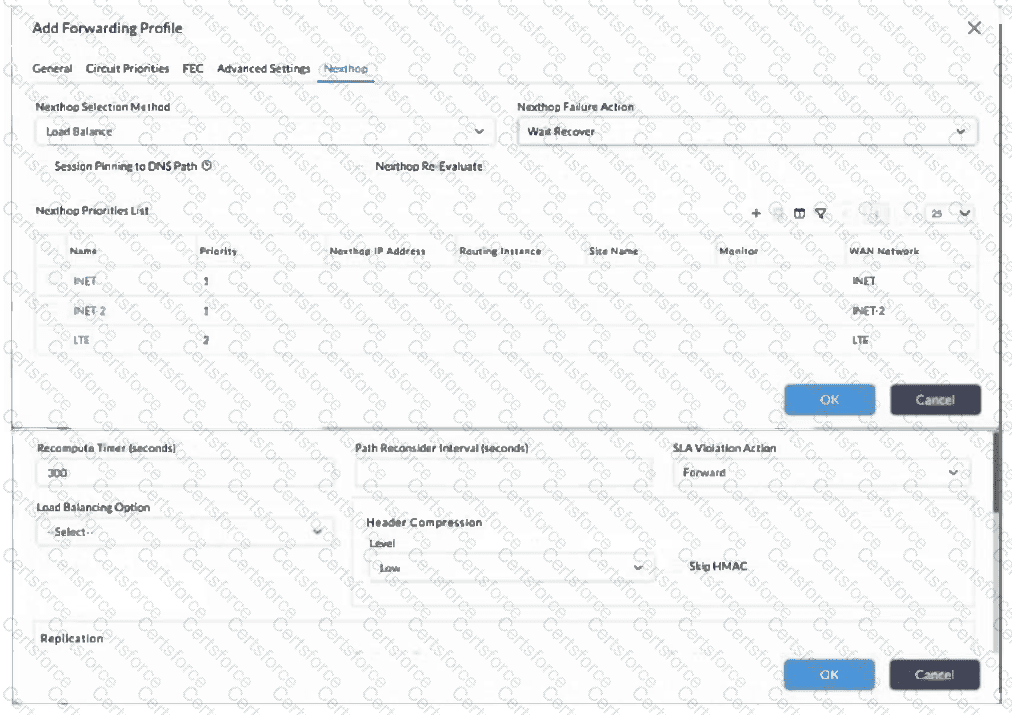
Question # 10

Options:

A.

The VOS device will determine the optimal path out of INET and INET-2 using a proprietary algorithm.


B.

The VOS device will load balance the sessions across INET and INET-2 as long as they are both SLA-compliant.


C.

The VOS device will start using the LTE traffic if the INET circuit becomes unavailable.


D.

The VOS device will not drop the traffic if there are no SLA-compliant nexthops.


Expert Solution
Viewing page 1 out of 2 pages
Viewing questions 1-10 out of questions
