
Black Friday Reward - Upto 75% off - Ends in 0d 00h 00m 00s - Coupon code: CFsave75

Pass the UiPath UiPath Certified Professional - Agentic Automation Track UiPath-AAPv1 Questions and answers with CertsForce

Viewing page 3 out of 4 pages
Viewing questions 21-30 out of questions
Questions # 21:

What approach is recommended when designing evaluations for agents with strictly defined, deterministic output requirements?

Options:

A.

Trajectory evaluators are best suited for deterministic outputs as they assess run history and behavioral patterns for exact matching.


B.

Use the LLM-as-a-Judge evaluator by default because of its ability to adapt to deterministic output requirements in addition to flexible outputs.


C.

Use any evaluator type interchangeably, as all evaluators produce equally reliable results for deterministic outputs.


D.

Use Exact match or JSON similarity evaluators for highly structured outputs, such as exact strings, numerical values, Boolean responses, or arrays of primitives.


Questions # 22:

An automation developer needs an agent to extract the invoice number from incoming emails without being given any examples.

How should the zero-shot system prompt be written for this simple task?

Options:

A.

Provide a short and direct instruction telling the agent to read the email content and return the invoice number if present.


B.

Include multiple example emails and expected invoice numbers to demonstrate the correct extraction pattern.


C.

Define several optional tools and escalation rules even though the task only requires simple text extraction.


D.

Add a long explanation about different invoice formats and detailed reasoning steps for every possible variation.


Questions # 23:

Which evaluator is best suited to verifying a boolean output that must be strictly true?

Options:

A.

JSON similarity, because it tolerates structure equivalence rather than single-value strict equality.


B.

Exact match, because it enforces a strict equality check on the boolean value without ambiguity.


C.

LLM-as-a-Judge, because it scores semantic similarity rather than strict boolean equality requirements.


D.

Trajectory evaluator, because it reviews behavior history instead of enforcing exact output equality.


Questions # 24:

Which of the following is a properly structured system prompt based on best practices?
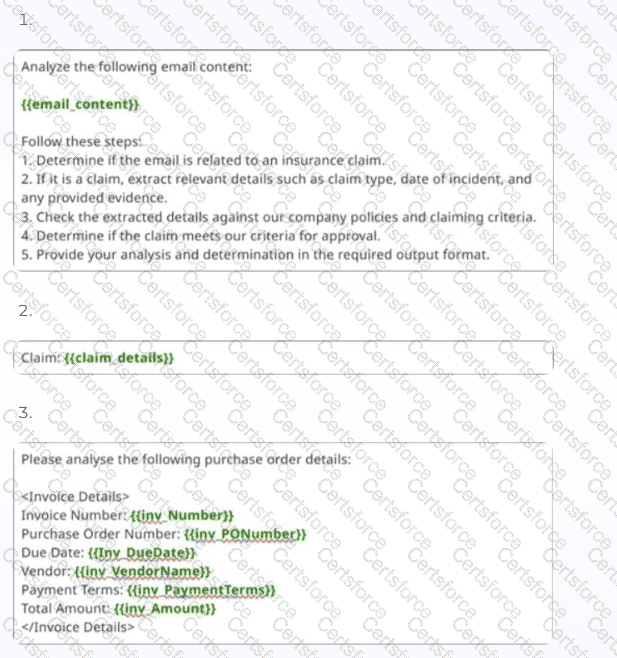
Question # 24

Original exhibit — Question 6, part 1
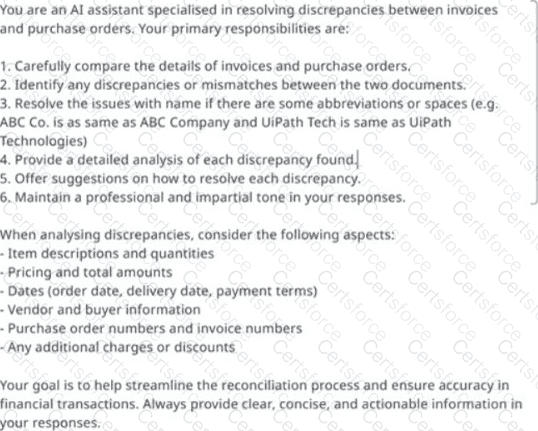
Question # 24

Original exhibit — Question 6, part 2

Options:

A.

1


B.

2 and 4


C.

3


D.

4


Questions # 25:

How can a UiPath process make sure that user input collected through the Properties Panel meets a specific format or set of constraints?

Options:

A.

Capture the input and handle errors later in a separate activity


B.

Rely on the Default Value to guide user input


C.

Apply Validation Rules directly to the input field


D.

Use the Input Label to describe the required format


Questions # 26:

If evaluation scores vary significantly between runs that use the same evaluation set and configuration, what is the most relevant interpretation?

Options:

A.

The agent's outputs may vary across executions, affecting reliability under consistent conditions.


B.

The expected outputs were automatically modified between executions, resulting in inconsistencies during the evaluation process.


C.

The execution trail disables semantic scoring during repeated runs, preventing similarity-based evaluation.


D.

The evaluation set structure prevents deterministic evaluators from running properly.


Questions # 27:

An agent can access multiple connector-based tools that have similar functionality.

How should the prompt help the agent select the correct tool?

Options:

A.

Assign similar descriptions to all tools so the agent can choose based on runtime confidence.


B.

Emphasize response formatting requirements instead of clarifying tool usage boundaries.


C.

Avoid detailed tool descriptions and rely on the model to interpret connector metadata.


D.

Differentiate each tool by clearly specifying its intended use case, scope, and triggering conditions.


Questions # 28:

When configuring the Search Strategy for a context in UiPath, what does the "Relevance score threshold" setting do?

Options:

A.

It establishes how frequently the index should be synced to ensure the agent references up-to-date information.


B.

It determines how many chunks are returned from a user's query, helping to control the overall token size of the LLM call.


C.

It filters out retrieved chunks that score below the threshold, making results more precise by only including the best-scored content.


D.

It sets the minimum number of documents that must be retrieved for the agent to provide a response.


Questions # 29:

An internal audit team creates a prompt requiring an agent to determine whether control descriptions are Adequate or Inadequate. The prompt contains the agent’s role, evaluation criteria, two labeled control examples, and a new description.

What is the primary advantage of this few-shot structured prompt?

Options:

A.

It removes the need to define success criteria because the examples implicitly establish them.


B.

It sets clear criteria and examples before evaluating the new control description.


C.

It allows the agent to modify the evaluation criteria based on similarities to the examples.


D.

It focuses primarily on formatting output instead of demonstrating how to apply the criteria.


Questions # 30:

Once a coded MCP server is registered in UiPath's MCP Servers panel, what triggers the discovery of its tools?

Options:

A.

A manual capability refresh initiated from the MCP Servers panel that forces immediate re-indexing of exposed tools


B.

Execution of the job associated with the MCP server registration, which establishes a live session and performs tool introspection


C.

A scheduled synchronization cycle that periodically polls the server endpoint for updated tool metadata


D.

An automatic heartbeat exchange that validates connectivity and refreshes the server's advertised capabilities


Viewing page 3 out of 4 pages
Viewing questions 21-30 out of questions