
Black Friday Reward - Upto 75% off - Ends in 0d 00h 00m 00s - Coupon code: CFsave75

Pass the UiPath UiPath Certified Professional - Agentic Automation Track UiPath-AAPv1 Questions and answers with CertsForce

Viewing page 1 out of 4 pages
Viewing questions 1-10 out of questions
Questions # 1:

A production environment has experienced intermittent failures across multiple agentic automations over the past month. An administrator needs to identify which specific agents are causing the most disruptions and understand the nature of these failures.

Which approach would best support this investigation?

Options:

A.

Filter by global agent view, review the completed instances chart, then examine agent descriptions and retention policies for configuration issues.


B.

Filter by the last day interval, review the instances success rate metric, then check the average processing time for all agents.


C.

Filter by the last month interval, review the top agents with most errors metric, then examine execution incidents filtered by the problematic agents.


D.

Filter by specific folder metrics, review the agent units consumption metric, then check system prompts configuration settings for each agent.


Questions # 2:

Which approach follows best practices for implementing a multi-agent system?

Options:

A.

Design agents to collaborate and coordinate at runtime, using shared memory or communication layers to negotiate objectives, distribute tasks, and adapt dynamically to changing conditions.


B.

Limit agent interaction to prevent complexity, assigning each agent a static function that never changes throughout the workflow lifecycle.


C.

Focus on repetitive, rules-based automations where agents follow fixed, deterministic paths and do not require adaptive planning or coordination.


D.

Define all control logic and task order during the initial design phase, ensuring agents execute a predetermined set of actions without deviation, following fixed rules and deterministic paths.


Questions # 3:

After observing a drop in retrievals, which action provides document-level details to verify whether fresh content was ingested successfully?

Options:

A.

Open the index's Sync job history and select a specific entry to view the ingested documents


B.

Change Interval to last month to display previews of the documents used for retrieval


C.

Click the Queries metric to open raw query logs for every search request


D.

Filter the index list by Last queried and export the table to review document details


Questions # 4:

An agent uses policy documents retrieved from a knowledge base to compose an answer. You need to verify that the generated answer strictly reflects the retrieved content and introduces no unsupported statements.

Which evaluator should you configure?

Options:

A.

Deterministic - JSON similarity


B.

Deterministic - Exact match


C.

LLM as a judge - Semantic similarity


D.

LLM as a judge - Faithfulness


Questions # 5:

While designing an agent story for invoice processing, the team identifies multiple decision points where different systems are used.

How should the agent design reflect these decision points?

Options:

A.

Minimize explicit decision modeling in the agent and instead trigger system automations sequentially, allowing system responses to implicitly determine the next step.


B.

Decompose each decision point into independent micro-agents aligned to individual systems, without maintaining centralized orchestration logic.


C.

Represent decisions as structured conditional branches within the agent, mapping them to the specific system tools required while preserving traceability and outcome alignment.


D.

Abstract decision points into a generalized reasoning layer within the agent and rely on downstream systems to enforce detailed validation and routing logic.


Questions # 6:

Which approach effectively balances strict and flexible assertions?

Options:

A.

Use strict checks for essential fields and flexible checks for non-critical text


B.

Apply strict checks uniformly to maintain consistent verification standards


C.

Exclude assertions altogether when workflows include creative or variable outputs


D.

Rely mainly on flexible checks to streamline evaluation and reduce maintenance effort


Questions # 7:

What must be configured to create an Automation Ops policy for a specific tenant?

Options:

A.

Policy name, Priority, Roles


B.

Policy name, Description, Roles


C.

Policy name, Priority, Description


D.

Policy name, Description, Period


Questions # 8:

How are activity input methods configured in UiPath agent tools, and what are the main considerations for cascading fields?

Options:

A.

Activity input methods include Prompt (default), Argument, and Static Value. Cascading fields cannot use the Prompt input method as agents cannot infer changes in field structures at runtime.


B.

Activity input methods are mostly limited to Prompt, though in some cases Argument or Static Value can be selected depending on the connector. Cascading fields generally work with the Prompt method because agents can usually handle dynamic field updates during execution without major issues.


C.

Activity input methods are fully automated with no optional configurations available. Cascading fields do not impact agent tool functionality in any way.


D.

Activity input methods primarily default to Static Value for most fields to ensure predictable behavior and minimize runtime errors. Cascading fields are automatically detected and adjusted by the agent at runtime for smooth handling of dependent or conditional inputs.


Questions # 9:

Which statement best distinguishes deterministic evaluators from LLM-based (model-graded) evaluators when designing agent evaluations?

Options:

A.

Deterministic evaluators apply predefined rule-based matching, always produce consistent results for identical inputs, omit a Model selection field since they do not use LLMs, and are best for strict exact matches such as booleans, specific numeric values, exact strings, or arrays of primitives.


B.

Deterministic evaluators produce probabilistic scores by sampling training examples and therefore can vary between identical runs to reflect uncertainty.


C.

Deterministic evaluators use a lightweight LLM to score outputs, allow selecting model and temperature for repeatable comparisons, and are therefore preferable for flexible language evaluation.


D.

Deterministic evaluators judge an agent's run behavior across intermediate steps and tool calls by applying semantic heuristics rather than exact matching of final outputs.


Questions # 10:

In the illustrated insurance-claim automation, the agent analyzes incoming emails and escalates uncertain cases for confirmation before proceeding.

When configuring Human-in-the-Loop for this process, which configuration best ensures accurate claim identification while maintaining automation efficiency?
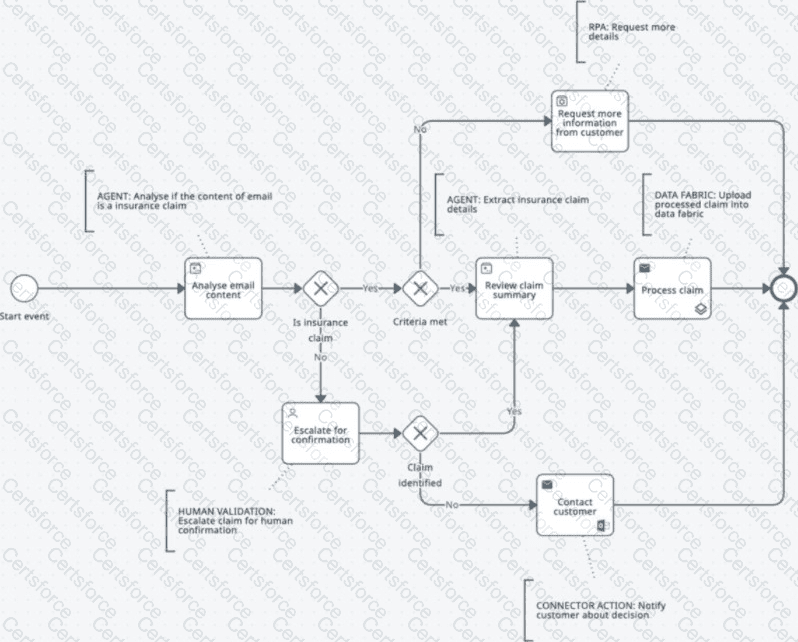
Question # 10

Original exhibit — Question 2

Options:

A.

Configure human approval before notifying the customer of the final claim decision, regardless of how the claim was classified.


B.

Configure human validation for a subset of processed claims selected based on predefined business priority categories.


C.

Configure escalation to a human reviewer when the agent can't confidently confirm the email is an insurance claim.


D.

Configure human review after the claim summary is generated to validate extracted details prior to uploading the processed claim into the data fabric.


Viewing page 1 out of 4 pages
Viewing questions 1-10 out of questions
