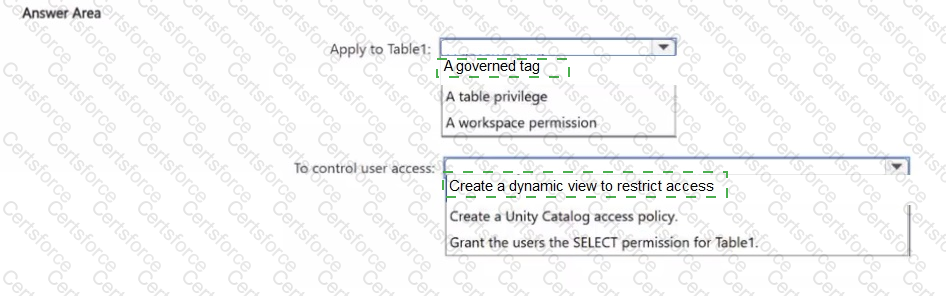
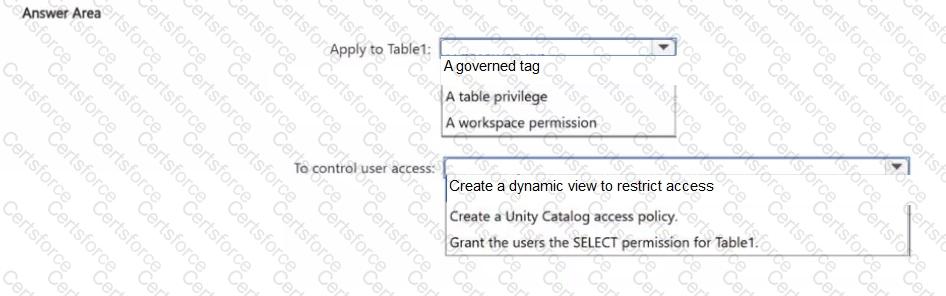
You have an Azure Databricks workspace that is enabled for Unity Catalog and contains a catalog named CatalogV Catalog1 contains a schema named Schema! and a table named Table1.
You need to ensure that access to the data in Table1 is controlled by using attribute based access control (ABAC).
What should you apply to Table1, and how should you control access for users? To answer, select the appropriate options in the answer area.
NOTE: Each correct selection is worth one point.
You have an Azure Databricks workspace that is enabled for Unity Catalog and contains a managed Delta table named Sales. Sales stores transaction data and contains the following columns:
• transactionjd (string)
• transaction date (date)
• amount (decimal)
You need to implement the following data quality requirements by using table-level data quality enforcement:
• amount must be greater than 0.
• transaction id must never be null.
• Invalid records must be rejected when data is written to the Sales table.
What should you do?
You have an Azure Databricks workspace that uses Unity Catalog.
You have a Lakeflow Spark Declarative Pipelines (SDP) pipeline that ingests data into a managed Delta table named Table1. Table! is used for analytics.
New columns are added to the source data, causing pipeline failures during writes to Table!
You need to prevent the pipeline failures. The solution must ensure that schema changes are detected and handled.
What should you do?
You have an Azure Databricks workspace named Workspace1 that contains a takehouse and is enabled for Unity Catalog.
You have a connection to a Microsoft SQL Server database named DB1.
You need to expose the schemas and tables of DB1 to meet the following requirements:
• The schemas and tables can be queried in Databricks.
• The schemas and tables appear alongside other Unity Catalog objects.
• The data is NOT copied into Databricks-managed storage.
Solution: You create a new native catalog in Unity Catalog. Does this meet the goal?
You have an Azure Databricks workspace that contains a Delta table named Table 1. Table 1 has accumulated obsolete files.
You need to reduce storage costs. The solution must preserve 30 days of time travel history. Which two actions should you perform? Each correct answer presents part of the solution.
NOTE: Each correct selection is worth one point.
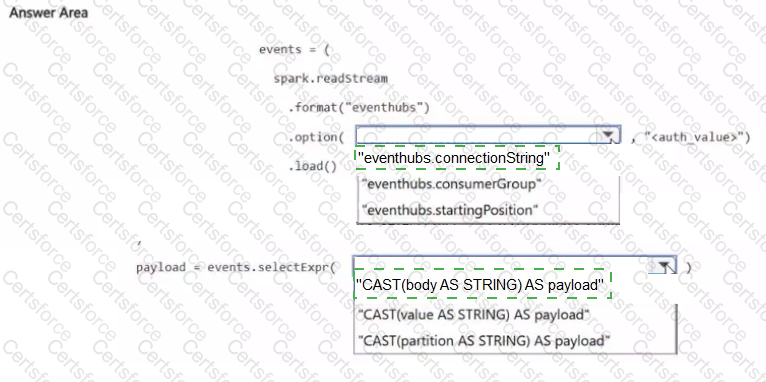
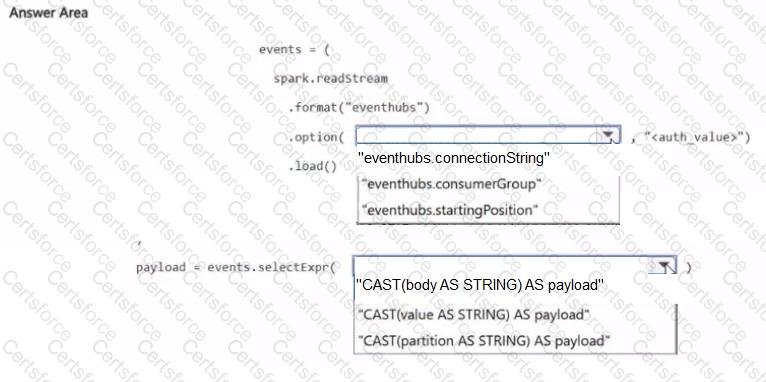
You have an Azure Databricks workspace.
You need to ingest streaming data from Azure Event Hubs by using Apache Spark Structured Streaming The solution must authenticate to Event Hubs and read the event payload.
How should you complete the PySpark code segment? To answer, select the appropriate options in the answer area.
NOTE: Each correct selection is worth one point.
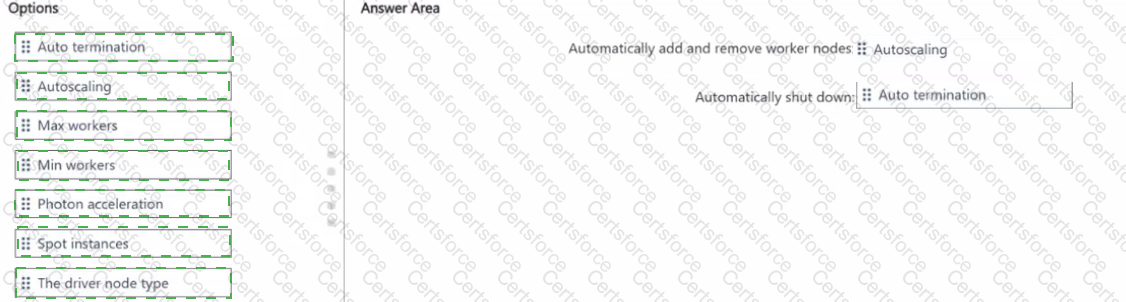
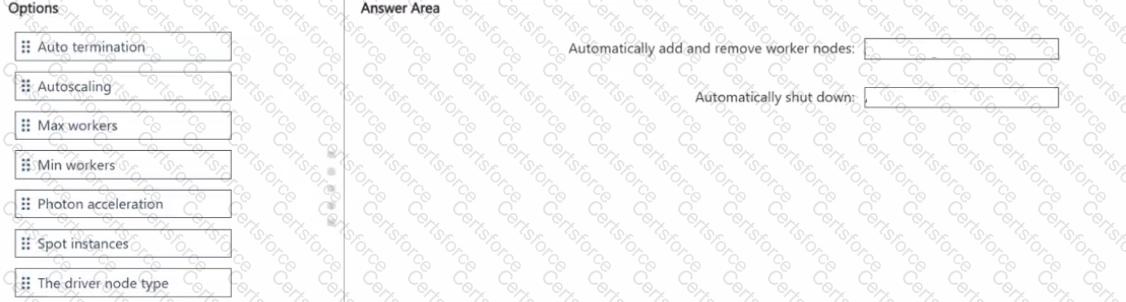
You have an Azure Databticks workspace that contains an all-purpose compute cluster named Cluster1. Cluser1 is used for
interactive development.
You need to configure Cluster1 to meet the following requirements:
• Automatically add and remove worker nodes based on workload demand
• Automatically shut down when the cluster has been idle for a specific period.
What should you configure for each requirement? To answer, drag the appropriate options to the correct requirements. Each option may be used once, more than once, or not at all. You may need to drag the split bar between panes or scroll to view content
NOTE: Each correct selection is worth one point.
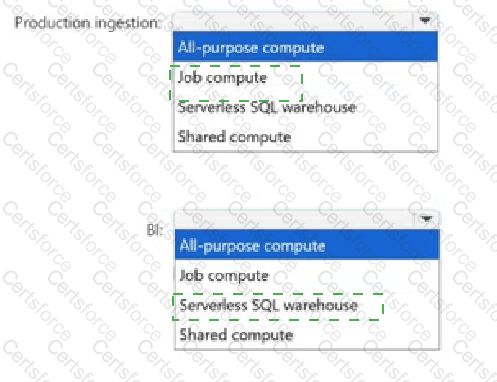
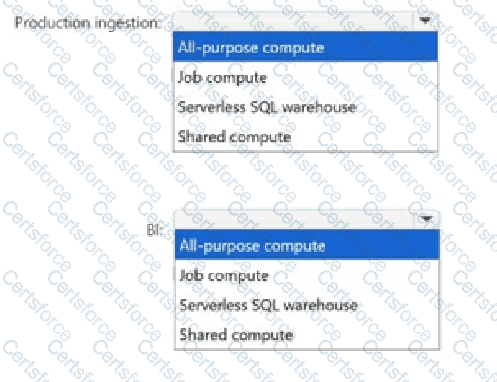
You need to recommend a compute type for the production ingestion workloads and BI workloads. The solution must meet the environment and compute requirements.
What should you recommend for each type of workload? To answer, select the appropriate options in the answer area.
NOTE: Each correct selection is worth one point.
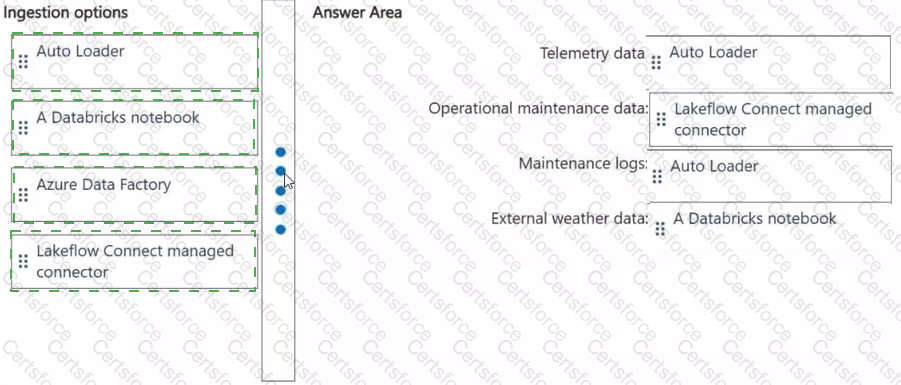
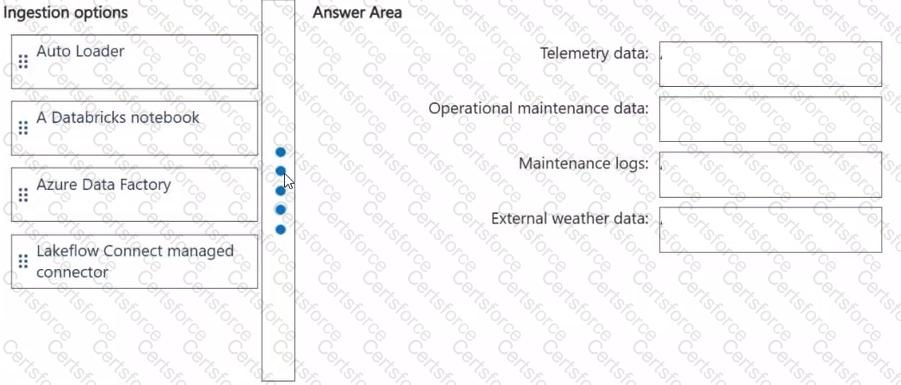
Which ingestion option should you recommend for each data source? To answer, drag the appropriate options to the correct data sources. Each option may be used once, more than once, or not at all. You may need to drag the split bar between panes or scroll to view content.
NOTE: Each correct selection is worth one point.
You have an Azure Databricks workspace that contains a job in Lakeflow Jobs named Job1. Job1 contains multiple tasks.
Failures of non-critical tasks must be logged but must NOT trigger notifications. Notifications must be triggered only when critical tasks have failed, and Job1 has completed
You need to configure the job alerting behavior.
What should trigger a notification?