
XYZ Regional Hospital is an integrated healthcare system consisting of hospitals, neighborhood health centers, and small doctor offices. XYZ Regional Hospital recently merged with 4x neighborhood health centers and 125 doctor branch offices. Its wireless, wired-access, and AAA solutions are outdated and require replacement.
XYZ Regional Hospital wants to future-proof and improve efficiency at all sites by enhancing wired and wireless access and moving to centralized, unified wired/wireless and policy management that provides uninterrupted availability for all systems.
Locations:
XYZ Regional Hospital is in New York City.
Dila Health Center is in City A.
Mount Health Center is in City B.
Rock Health Center is in City C.
Branch clinics are in different locations across the United States.
Requirements:
Provide, through management software, a single pane of glass to manage wired and wireless LANs and VPNs across campus, branch, and remote environments through a web/cloud architecture that delivers near-real-time insight, troubleshooting tools, and Service Level performance reporting.
Provide seamless integration across wired, wireless, WAN, SD-Branch, and IoT.
Provide secure wireless access for all Regional Hospital employees and partners, and provide wireless Internet access to medical citizens when they visit the facilities.
All access points must support these features and specifications: 802.11 ax (Wi-Fi 6E Certified).
Include security options such as WP2/WPA3 and 802.1X with Radius secure authentication.
Identify and authenticate every wireless and wired device.
Provide end-to-end role-based security.
Provide seamless mobility across the hospital for medical teams, patients, and visitors.
Reduce Wi-Fi deployment time from days to hours and enable Zero-Touch deployments across the site.
Establish a resilient, future-ready network infrastructure with the intelligence, scalability, and intuitive toolsets needed to meet emerging needs.
Provide a fully redundant branch solution with dynamic path selection to the hospital.
The hospital CIO wants to review the phase 1 approach and framework that will be used to achieve the network-refresh project goals.
What is the phase 1 task?
You are designing a solution with OS10-based access points and redundant gateways, with these requirements:
Wi-Fi6E-based access points
Support for tunneled traffic
Application visibility
Rogue APs
Live upgrades
Air Slice
Cloud Guest Authentication
AI Insights
Which licenses are required?
Choose two.
During the stakeholder interview, an agenda is created to clarify customer expectations. The customer is concerned about future business requirements, with network scalability and flexibility being key.
Which expectations should be considered to solve upcoming business problems?
Choose two.
You are responding to a customer’s Request for Proposal (RFP) for a new network-infrastructure solution. The RFP describes the customer’s desired features and technical outcomes but does not specify several important design details.
At this point in the proposal process, you must document the assumptions made to complete the design and address gaps in the RFP. These assumptions should represent reasonable expectations that guide the customer’s understanding of the solution and highlight areas that may require further clarification.
What is a valid example of an assumption that should be presented to the customer in your RFP response?
What is one scenario in which designing a 2-tier campus LAN is preferable to using a 3-tier design?
Your organization plans to deploy HPE Aruba Networking User Experience Insight (UXI) sensors to improve network visibility and proactive troubleshooting throughout its enterprise environment. The objective is to continuously monitor user experience, application performance, and network health across wired, wireless, and WAN segments.
Which capabilities accurately describe the features and requirements of HPE Aruba Networking UXI sensors?
Choose two.
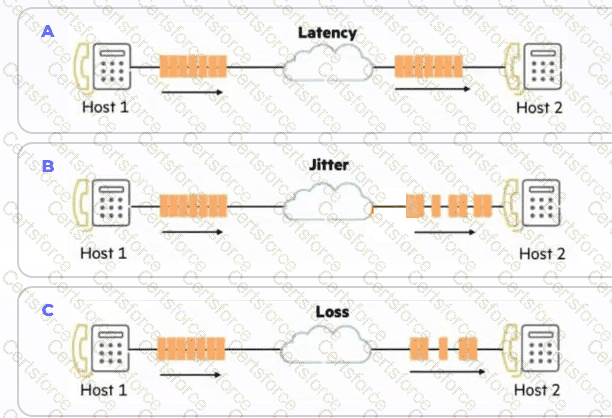
The client’s current network has occasional voice dropouts during phone calls between office locations. It has been determined that no packet loss is occurring, and QoS is the likely cause.
Which phenomenon is the client currently experiencing issues with?
Original exhibit — Question 36
You are meeting with different stakeholders in a customer’s IT organization as part of an HPE Aruba Networking campus access-layer design project. You need to collect technical input that supports design decisions, including switch-port capacity, uplink requirements, and user-connectivity needs.
Which two stakeholders participate in these design activities?
Choose two.
