Jitter represents the variation in packet transmission delay over time and is particularly detrimental to real-time communications such as Voice over IP.
Voice applications generate a continuous stream of packets that must arrive at reasonably consistent intervals for smooth playback.
When packets experience variable queuing delays, they may arrive irregularly, creating interruptions in the reconstructed audio stream.
Even when no packets are lost during transmission, excessive jitter can produce audible dropouts if packets arrive too late to be used by the receiving jitter buffer.
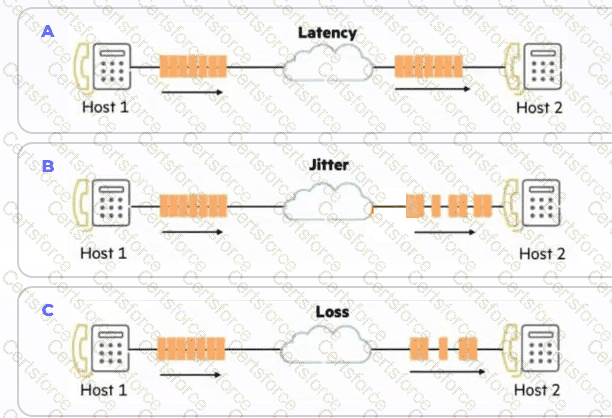
The scenario identifies intermittent voice dropouts, an absence of measured packet loss, and a suspected QoS problem. These conditions strongly indicate excessive jitter.
Option A represents latency, which measures packet transmission delay. High latency produces conversational delays and may cause users to interrupt one another, but does not necessarily produce intermittent audio gaps.
Option C represents packet loss, where transmitted packets fail to reach the destination. The scenario explicitly excludes that condition.
QoS mechanisms such as appropriate DSCP classification, traffic prioritization, queue management, and congestion avoidance help reduce jitter.
The architect should examine WAN interface utilization, queue statistics, DSCP preservation, and end-to-end voice performance before recommending configuration changes.
Official HPE Reference Topics: HPE Aruba Networking AOS-CX Quality of Service Guide — Traffic Classification and Scheduling; Unified Communications and Collaboration — Voice Performance Monitoring.
===============


Submit