Spring Sale Limited Time 70% Discount Offer - Ends in 0d 00h 00m 00s - Coupon code: simple70

Pass the F5 F5-CA F5CAB3 Questions and answers with CertsForce

Viewing page 2 out of 3 pages
Viewing questions 11-20 out of questions
Questions # 11:

A BIG-IP Administrator configures a Virtual Server to load balance traffic between 50 webservers for an ecommerce website. Traffic is being load balanced using the Least Connections (node) method. The webserver administrators report that customers are losing the contents from their shopping carts and are unable to complete their orders. What should the BIG-IP Administrator do to resolve the issue?

Options:

A.

Change Default Persistence Profile setting to cookie


B.

Change Default Persistence Profile setting to sip_info


C.

Change Load Balancing method to Ratio (node)


D.

Change Load Balancing method to Ratio (member)


Expert Solution
Questions # 12:

Due to a change in application requirements, a BIG-IP Administrator needs to modify the configuration of a Virtual Server to include a Fallback Persistence Profile.

Which persistence profile type should the BIG-IP Administrator use?

Options:

A.

SSL


B.

Hash


C.

Universal


D.

Source Address Affinity


Expert Solution
Questions # 13:

Users report that traffic is negatively affected every time a BIG-IP device fails over. The traffic becomes stabilized after a few minutes. What should the BIG-IP Administrator do to reduce the impact of future failovers?

Options:

A.

Set up Failover Method to HA Order


B.

Enable Failover Multicast Configuration


C.

Configure MAC Masquerade


D.

Configure a global SNAT Listener


Expert Solution
Questions # 14:

The BIG-IP Administrator has to provide encrypted communication between users and the virtual server they access. Multiple hostnames are configured in DNS with the same IP address.

Which profile type and setting in the profile should be used? (Choose one answer)

Options:

A.

Client SSL, Client Name


B.

Server SSL, Server Name


C.

Client SSL, Server Name


D.

Server SSL, Client Name


Expert Solution
Questions # 15:

Refer to the exhibit.

Question # 15

Question # 15

A BIG-IP Administrator configures a new VLAN on an HA pair of devices that does NOT yet have any traffic. This action causes the assigned traffic group to fail over to the standby device. Which VLAN setting should be changed to prevent this issue?

Options:

A.

Auto Last Hop


B.

Source Check


C.

Fail-safe


D.

Customer Tag


Expert Solution
Questions # 16:

A Standard Virtual Server reports poor performance for Internet users.

What TCP profile configuration should be applied?

Options:

A.

Client: f5-tcp-wan / Server: f5-tcp-lan


B.

Client: f5-tcp-lan


C.

Client: f5-tcp-lan / Server: f5-tcp-wan


D.

Client: f5-tcp-optimized


Expert Solution
Questions # 17:

A Standard Virtual Server is configured with SNAT Automap. Backend servers must see the original client IP.

What should be configured?

Options:

A.

Performance (HTTP) VS


B.

HTTP profile with X-Forwarded-For


C.

HTTP Transparent profile


D.

SNAT pool with client IP


Expert Solution
Questions # 18:

Where in the configuration utility should the BIG-IP Administrator verify the pool member currently assigned to a pool is on port 80?

Options:

A.

Local Traffic > Nodes: Node List. Select the node in question, view the Health Monitor next to Configuration.


B.

Local Traffic > Pools: Pool List. Select the pool in question, select Members tab, view the configured Health Monitor.


C.

Local Traffic > Pools: Pool List. Select the pool in question, select the Members tab, view the configured Service Port.


Expert Solution
Questions # 19:

All pool members are online. All other virtual server settings are at default.

What might alter the load balancing behavior? (Choose one answer)

Options:

A.

Adding a OneConnect profile


B.

Enabling SNAT automap


C.

Enabling a fallback host in the HTTP profile


D.

Adding a persistence profile


Expert Solution
Questions # 20:

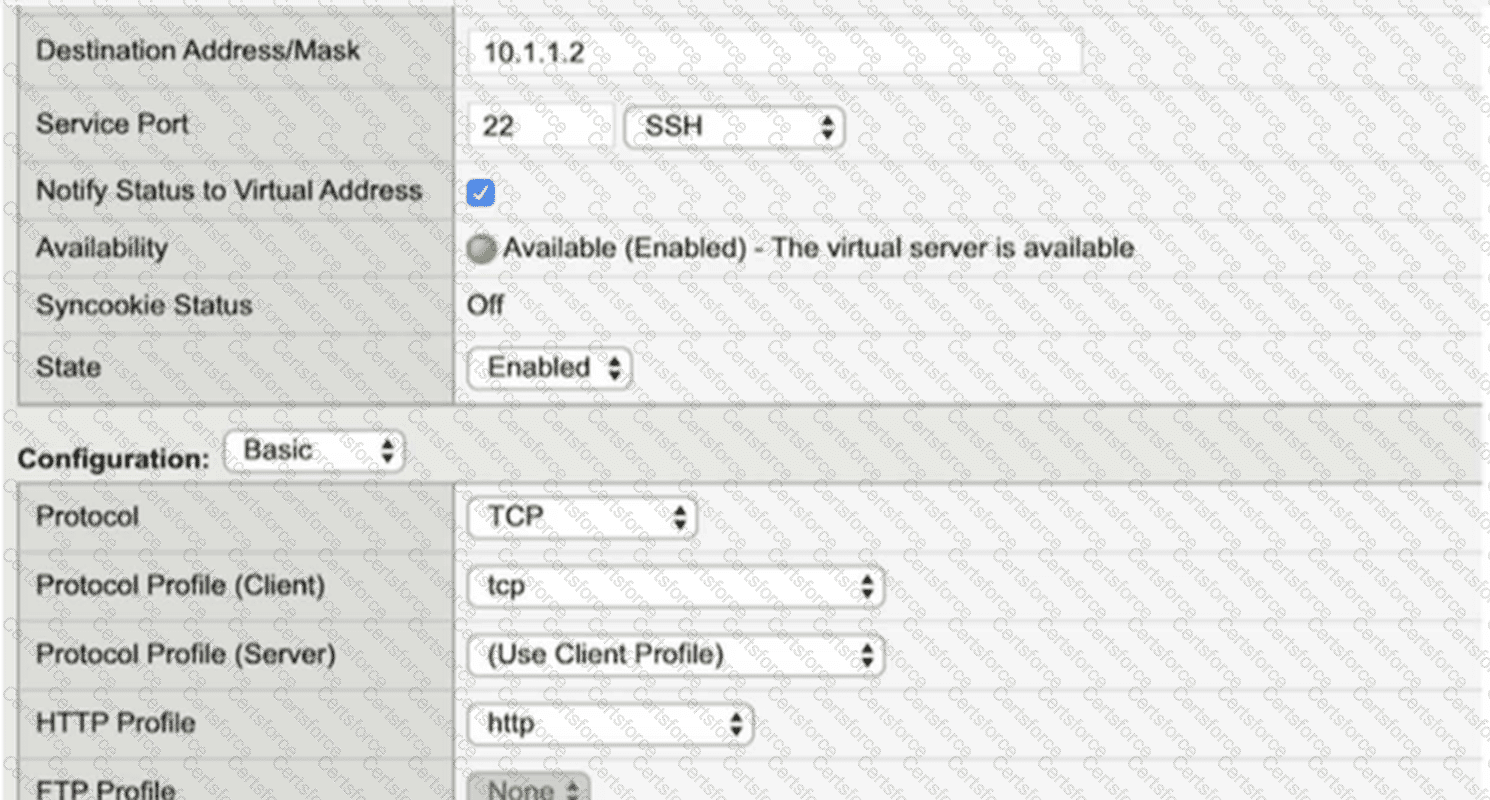
A BIG-IP Administrator creates a new Virtual Server to load balance SSH traffic. Users are unable to log on to the servers.

What should the BIG-IP Administrator do to resolve the issue?

Options:

A.

Set Protocol to UDP


B.

Set HTTP Profile to None


C.

Set Source Address to 10.1.1.2


D.

Set Destination Address/Mask to 0.0.0.0/0


Expert Solution
Viewing page 2 out of 3 pages
Viewing questions 11-20 out of questions