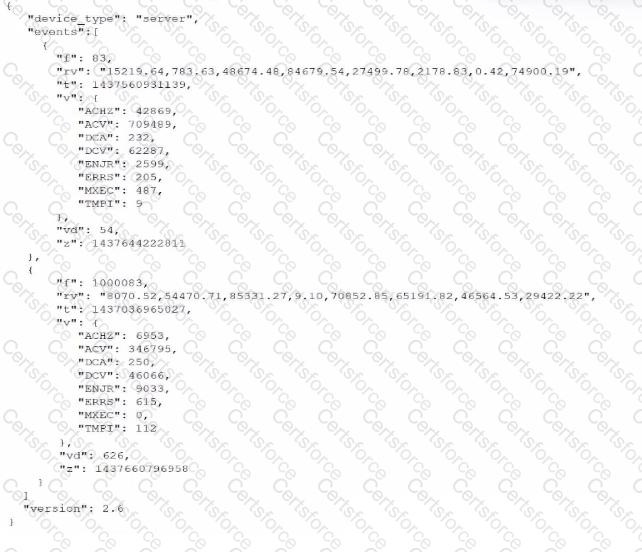
A single variant data column table RAW_SOURCE has the following JSON records:
A Data Analyst needs to get the value of the "f" field and have it in a consumable, tabular format. Which query should be used to meet this requirement?
A.
select data:events:f::number from raw_source;
B.
select value:f::number from raw_source, lateral flatten( input => data );
C.
select src.events:f::number from raw_source src;
D.
select value:f::number from raw_source, lateral flatten( input => data:events );
Working with nested semi-structured data requires a deep understanding of Snowflake's FLATTEN function and path notation. In the provided JSON exhibit, the data is hierarchical: the root contains a key named "events", which is an array containing multiple objects. Each object within that array contains the target field "f".
To transform this into a "consumable, tabular format" where each instance of "f" appears as a separate row, the Data Analyst must "explode" the array. Simply using path notation like data:events:f (Option A) will fail or return NULL because the engine cannot directly map a single path through an array structure to multiple scalar results without an explicit relational transformation.
The LATERAL FLATTEN function is the standard tool for this task. It takes a semi-structured column (or a specific path within it) as an input and returns a relational result set. By specifying input => data:events, the Analyst instructs Snowflake to look specifically at the array. For every element found in that array, FLATTEN generates a new row in the result set. The output of the flatten operation includes a column named VALUE, which represents the specific element (in this case, an object) currently being processed.
Evaluating the Options:
Option A and C are incorrect because they attempt to use direct pathing on an array. Without flattening, the query engine sees the array as a single block of data and cannot reach the "f" key inside individual array elements.
Option B is incorrect because it flattens the root data object. While this works for top-level keys, it wouldn't automatically iterate through the "events" array to expose the "f" values inside it; it would treat the entire array as a single value.
Option D is the 100% correct answer. It correctly targets the "events" array for flattening and then utilizes path notation (value:f) followed by the appropriate type casting (::number) to produce the final tabular output. This is a core competency for any SnowPro Advanced Data Analyst handling modern telemetry or event-based data.
Contribute your Thoughts:
Chosen Answer:
This is a voting comment (?). You can switch to a simple comment. It is better to Upvote an existing comment if you don't have anything to add.


Submit