A Nokia VPRN service maintains a dedicated Virtual Routing and Forwarding (VRF) instance for customer-specific routing information. Customer routes can be learned through directly connected interfaces, static routing, BGP, OSPF, or other supported routing mechanisms.
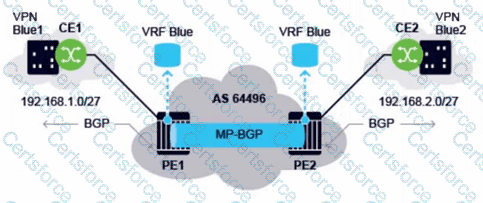
In this scenario, CE1 advertises its system address to PE1 through the configured PE-CE BGP relationship. Once the route is accepted and becomes eligible for VPN export, PE1 can advertise it to PE2 using MP-BGP.
Nokia SR OS supports simplified VPRN route distribution through the vrf-target configuration. This configuration provides the applicable Route Target associations required to export and import VPN routing information without requiring separately defined routing policies.
PE1 associates the customer prefix with a Route Distinguisher, attaches the relevant Route Target extended community, and advertises the VPN route together with its service label.
PE2 imports the route when its VPRN import Route Target matches the advertised community and the route satisfies the applicable acceptance requirements.
An explicit vrf-export or vrf-import policy is required only when additional policy control is necessary or when the simplified Route Target mechanism is not configured.
Therefore, option C is correct under standard VPRN Route Target configuration and normal route eligibility conditions.
[Reference:Nokia SR OS Layer 3 Services Guide — VPRN Route Redistribution, VRF Targets and MP-BGP.]


Submit