Nokia SR OS supports periodic reoptimization of RSVP-TE LSPs through the MPLS resignal timer. This mechanism allows an established LSP to move to a more efficient path when network conditions change.
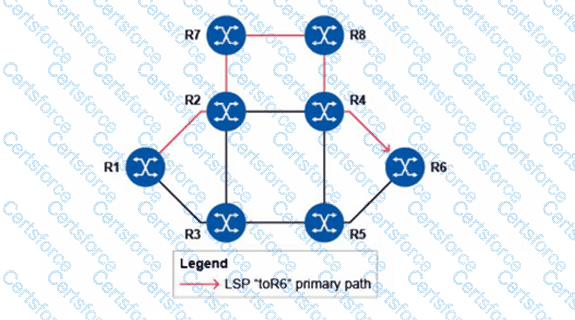
The currently established path contains five links:
R1 → R2 → R7 → R8 → R4 → R6.
Because every link has an equal cost, a shorter eligible path such as R1–R2–R4–R6 has a lower cumulative metric, assuming all other traffic-engineering constraints are satisfied.
However, the availability of a better path does not automatically cause immediate reoptimization. Under timer-based operation, the router waits until the configured resignal interval expires before requesting a new CSPF calculation.
If an appropriate lower-cost path is discovered, the router can establish it using Make-Before-Break (MBB). This mechanism allows the replacement LSP to be signaled successfully before the original LSP is removed, minimizing traffic interruption.
Failure recovery is separate from periodic optimization and may trigger local repair or LSP resignaling before the optimization timer expires.
Therefore, the assertion that the LSP immediately switches whenever a better path becomes available is false.
[Reference:Nokia SR OS MPLS Guide and Classic CLI Command Reference — RSVP-TE LSP Reoptimization and Resignal Timer.]


Submit