Microsoft Administering Windows Server AZ-802 Question # 25 Topic 3 Discussion
AZ-802 Exam Topic 3 Question 25 Discussion:
Question #: 25
Topic #: 3
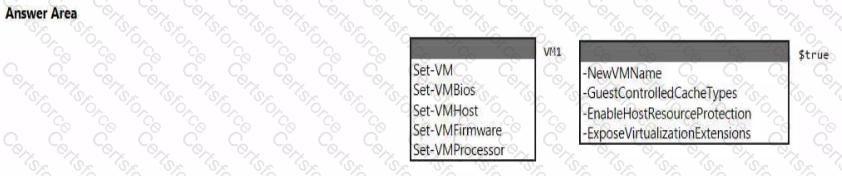
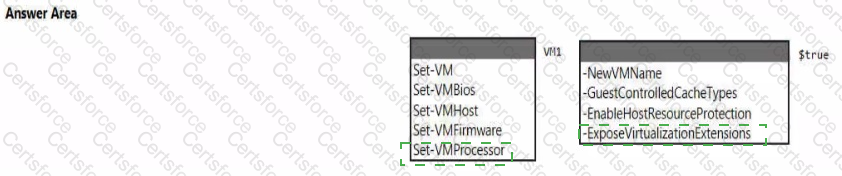
You need to meet the technical requirements for VM1. Which cmdlet should you run first? To answer, select the appropriate options in the answer area. NOTE: Each correct selection is worth one point.
The requirement is to run virtual machines on VM1 itself, which means enabling nested virtualization so that VM1 (a guest VM hosted on Server2) can install Hyper-V and host its own virtual machines. Nested virtualization on Hyper-V requires the parent VM ' s virtual processor to expose the host ' s hardware virtualization extensions (Intel VT-x or AMD-V) through to the guest. This is done with the Set-VMProcessor cmdlet using the -ExposeVirtualizationExtensions parameter set to $true, run against VM1 from the Hyper-V host (Server2): Set-VMProcessor -VMName VM1 -ExposeVirtualizationExtensions $true. VM1 must be turned off before this setting can be applied, and after it is applied, VM1 needs the Hyper-V role installed inside the guest before it can run its own VMs. Set-VM, Set-VMBios, Set-VMHost, and Set-VMFirmware do not control virtualization extension exposure: Set-VM manages general VM configuration such as memory and name, Set-VMHost configures host-wide settings, and Set-VMFirmware/Set-VMBios control boot and firmware settings for generation 2 and generation 1 VMs respectively. Only Set-VMProcessor with -ExposeVirtualizationExtensions satisfies the stated requirement, making it the correct first step.
Contribute your Thoughts:
Chosen Answer:
This is a voting comment (?). You can switch to a simple comment. It is better to Upvote an existing comment if you don't have anything to add.


Submit