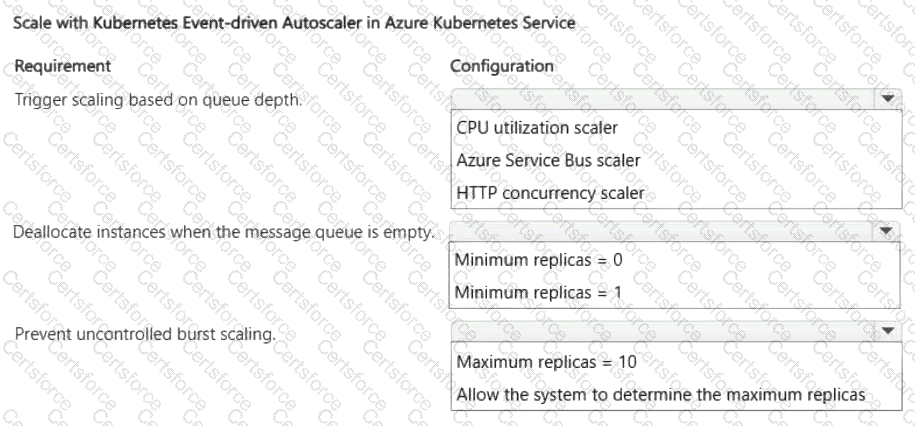
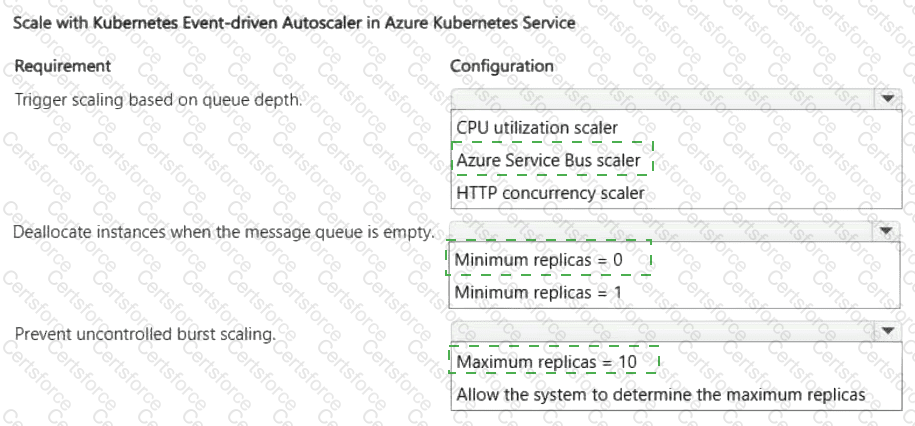
The batch retraining workload must scale according to queue length , so the correct KEDA trigger is the Azure Service Bus scaler . KEDA integrates with Azure Service Bus and monitors queue or subscription metrics, allowing AKS workloads to scale according to the number of pending messages rather than CPU utilization or HTTP request concurrency. Microsoft documents KEDA as the event-driven autoscaling mechanism for AKS and specifically supports Azure-based scalers for queue-driven workloads.
To meet the requirement to deallocate workload instances when no messages remain, configure minimum replicas = 0 . KEDA supports scale-to-zero for event-driven workloads, which is particularly appropriate for intermittent batch or machine-learning processing because no pods need to remain running while the queue is empty. Microsoft specifically identifies scale-to-zero as a KEDA capability and recommends it for sporadic ML workloads where cost optimization is important.
Finally, configure maximum replicas = 10 . A finite maximum replica count establishes an explicit upper scaling boundary, preventing large queue bursts from creating an uncontrolled number of worker replicas and protecting both infrastructure cost and downstream services.
Study Guide references: AKS → KEDA; Azure Service Bus event-driven scaling; minReplicaCount; maxReplicaCount; scale-to-zero; autoscaling limits.
Contribute your Thoughts:
Chosen Answer:
This is a voting comment (?). You can switch to a simple comment. It is better to Upvote an existing comment if you don't have anything to add.


Submit