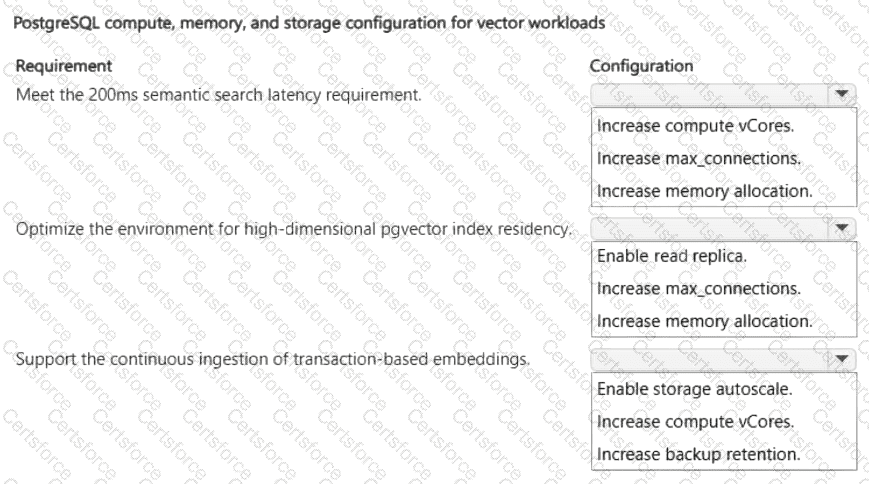
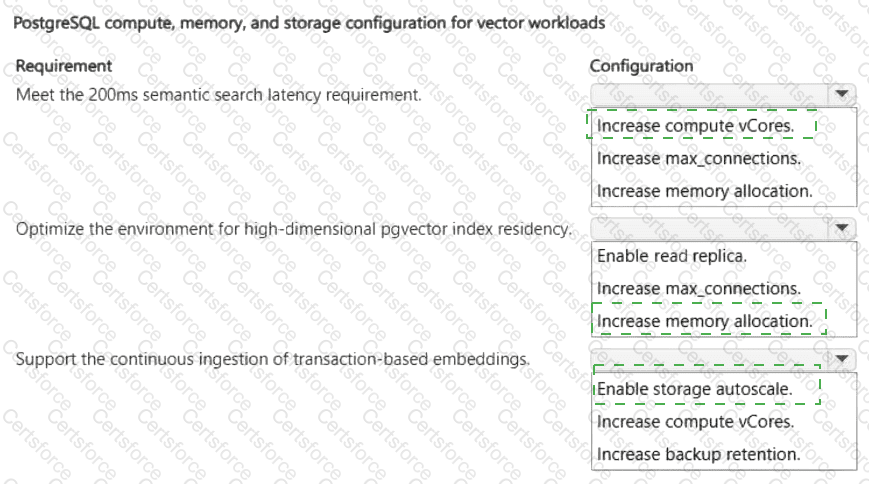
Meet the 200-ms semantic search latency requirement: Increase compute vCores.
Optimize the environment for high-dimensional pgvector index residency: Increase memory allocation.
Support the continuous ingestion of transaction-based embeddings: Enable storage autoscale.
For the strict sub-200-ms vector-search latency target, increasing compute vCores is the appropriate choice. Vector similarity operations are computationally intensive, and additional CPU capacity improves mathematical throughput and parallel query execution. Microsoft’s pgvector guidance emphasizes query-plan optimization, ANN indexes such as HNSW, and sufficient compute resources when optimizing vector workloads.
For high-dimensional pgvector index residency , increase memory allocation . HNSW provides strong query-performance characteristics but consumes more memory than IVFFlat. Keeping frequently accessed vector index structures in memory minimizes disk access and materially improves latency. Microsoft explicitly notes that HNSW requires more memory while providing a better speed/recall tradeoff.
For the continuous ingestion of millions of embeddings, enable storage autoscale . Azure Database for PostgreSQL Flexible Server can automatically increase allocated storage as capacity approaches configured thresholds, avoiding an out-of-storage condition as data volumes grow. Microsoft recommends storage autogrow for workloads whose storage demand can increase dynamically.
Increasing max_connections does not directly improve vector computation or index residency, read replicas primarily scale reads, and backup retention does not address ingestion capacity.
Study Guide references: Azure Database for PostgreSQL Flexible Server → pgvector performance optimization; compute and memory sizing; HNSW indexing; storage autogrow.


Submit