Setting to modify
Correct Configuration
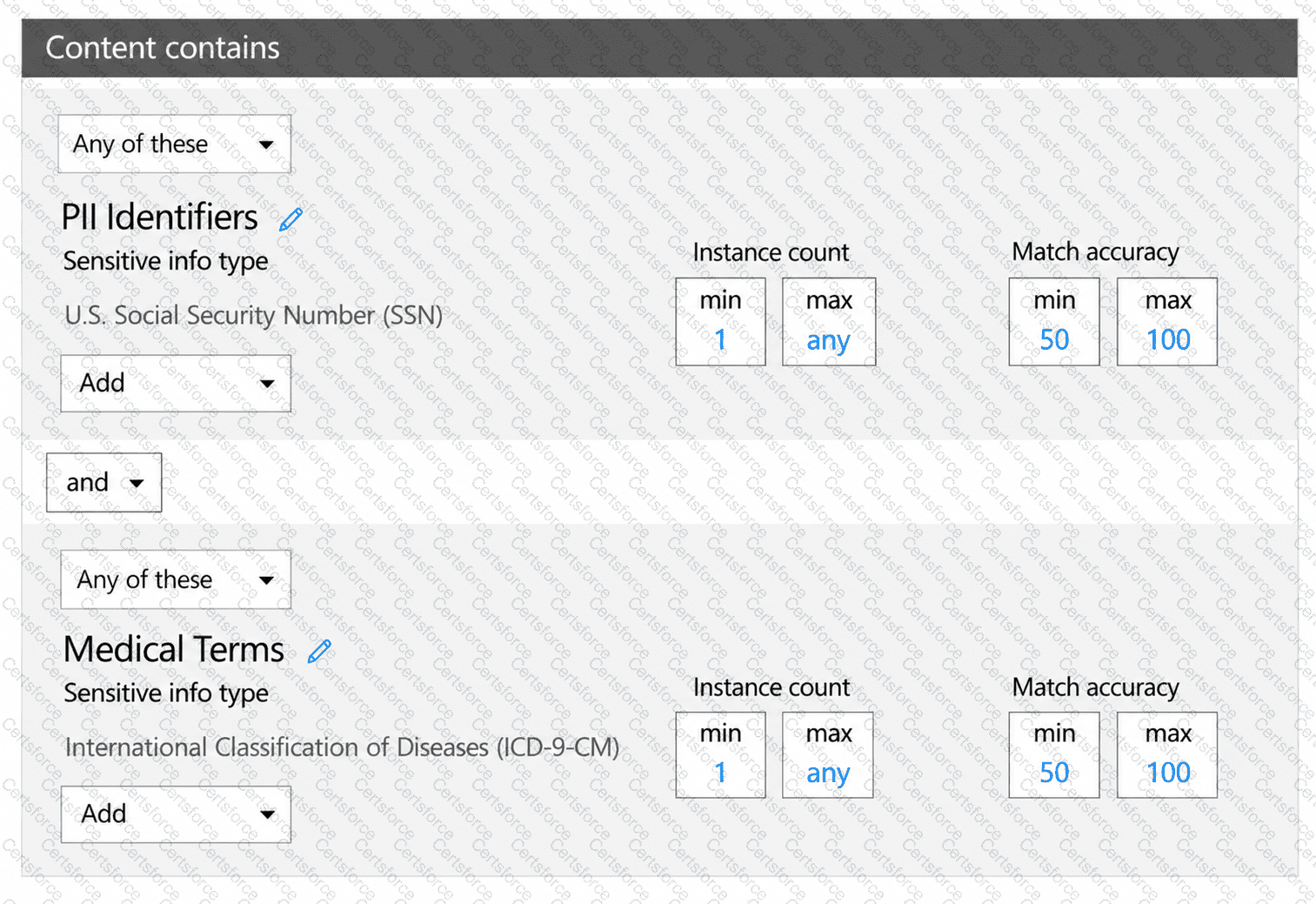
Logical operator between PII Identifiers and Medical Terms
Change and to or
Medical Terms → Match accuracy → min
Increase from 50 to 85 (High confidence)
Microsoft Purview Data Loss Prevention uses sensitive information types (SITs), Boolean operators, and confidence levels to determine whether content matches a DLP rule.
First selection: Change AND to OR.
The exhibit currently combines PII Identifiers and Medical Terms using an AND operator. This requires content to contain both a U.S. Social Security Number and an ICD-9-CM medical term before the rule matches.
Consequently, medical content without a Social Security Number will not trigger the policy.
Changing the operator to OR allows the rule to detect ICD-9-CM information independently, increasing the likelihood of identifying medical content.
Second selection: Increase minimum match accuracy to 85.
Microsoft defines high-confidence ICD-9-CM matches using corroborating dictionary evidence within a 300-character proximity.
Increasing the minimum match accuracy from 50 to 85 ensures that the medical terms condition matches only the high-confidence pattern.
This reduces false positives caused by ambiguous medical terminology, although some genuine matches with insufficient supporting evidence might be missed.
Important consideration: Changing AND to OR also permits Social Security Number-only matches. If the production requirement is to detect exclusively medical content, removing the unrelated PII condition would be more precise.
The two requested configuration changes provide broader medical-content detection while increasing classification confidence.
Microsoft References:
Microsoft Learn — DLP rules, conditions, and logical operators .


Submit