Verified Answer: =
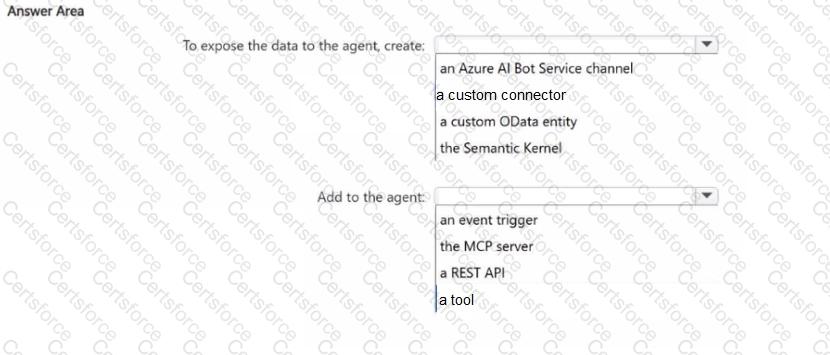
To expose the data to the agent, create: a custom connector
Add to the agent: the MCP server
The custom agent must answer questions about product specifications and compliance information, and the case study states that the R & D department already has a custom Model Context Protocol (MCP) server containing that information.
The best design is:
create a custom connector to expose that external capability cleanly to the low-code Copilot solution
add the MCP server to the agent so the agent can use that external knowledge/tooling source
Why this is correct:
The MCP server already exists and contains the needed product-specification and compliance data.
In a Copilot/agent design, you need a way to expose external functionality and data in a reusable, secure way. A custom connector is the low-code integration mechanism that fits this requirement.
Then the agent can use the MCP server as the connected external capability for answering those questions.
Why the other options are not correct:
Azure AI Bot Service channel is for communication channels, not for exposing this knowledge source.
a custom OData entity is not the right pattern for integrating the existing MCP-based capability.
the Semantic Kernel is a developer orchestration framework, but the requirement emphasizes using the existing MCP technology in a low-code solution.
an event trigger is unrelated to exposing R & D specification/compliance knowledge.
a REST API is too generic here; the scenario specifically points to the existing MCP server.
a tool is close conceptually, but the most direct answer choice tied to the existing R & D technology is the MCP server.



Submit