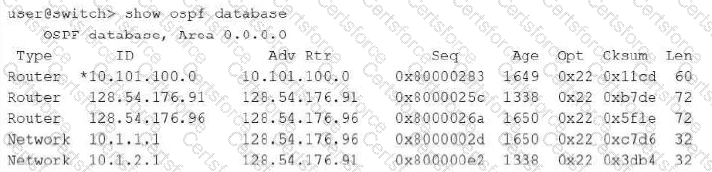
In the output of show ospf database, Junos marks every self-originated link-state advertisement with an asterisk immediately preceding the LSA's link-state ID. A self-originated LSA is one that was created and flooded by the router on which the command is being executed, as opposed to an LSA that was received from and originated by a neighboring router elsewhere in the area. In this exhibit, the asterisked Router LSA has an ID of 10.101.100.0 and an Advertising Router value of the same 10.101.100.0, confirming that this particular Router LSA describes the local device's own links, area membership, and interface costs, and that the local router itself flooded this LSA into the area's link-state database. This distinction matters operationally because when troubleshooting OSPF topology or SPF calculation issues, engineers frequently need to isolate their own router's advertised state from the states advertised by every other router in the area; the asterisk provides an immediate, unambiguous visual cue for that separation without needing to cross-reference the router's own ID separately. It has no relationship to designated router or backup designated router status — DR/BDR roles are indicated elsewhere in interface-level output, not through the asterisk convention in the LSA database dump, and a router that is neither DR nor BDR still self-originates and flags its own Router LSA the same way. Reference topics: Junos Enterprise Routing – OSPF, Interpreting the OSPF Link-State Database.
Contribute your Thoughts:
Chosen Answer:
This is a voting comment (?). You can switch to a simple comment. It is better to Upvote an existing comment if you don't have anything to add.


Submit