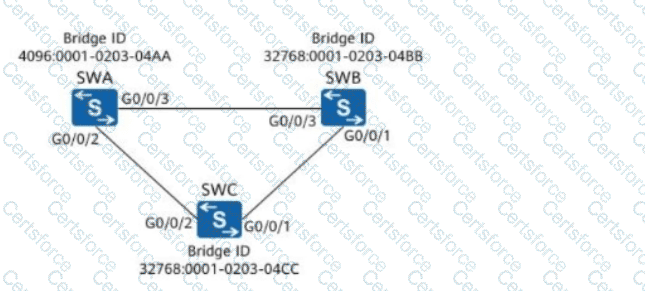
Detailed Explanation:In a Spanning Tree Protocol (STP) environment, the root bridge is selected based on the bridge ID. Here, SWA has the lowest bridge ID (4096:0001-0203-04AA), making it the root bridge. For each network segment, STP elects one designated port to forward traffic, and all other ports in that segment will be blocked to prevent loops.
Following the STP rules:
SWA is the root bridge, so all of its ports (G0/0/2 and G0/0/3) will be designated ports.
Each non-root switch (SWB and SWC) selects one root port, which is the port with the lowest path cost to the root bridge (SWA).
SWB ' s G0/0/3 will have a higher path cost when compared with G0/0/1 (if assuming equal link costs), thus making G0/0/1 the root port on SWB.
SWB will then block its G0/0/3 port to prevent a loop, as SWA ' s G0/0/3 is already the designated port for that link.
Hence, G0/0/3 of SWB will be in the blocking state to maintain a loop-free topology
Contribute your Thoughts:
Chosen Answer:
This is a voting comment (?). You can switch to a simple comment. It is better to Upvote an existing comment if you don't have anything to add.


Submit