OSPF route summarization is a critical technique for managing the size of the Link State Database (LSDB) and the routing table by consolidating multiple specific routes into a single aggregate advertisement.
Summarization Point: In OSPF, inter-area summarization (consolidating Type 1 and Type 2 LSAs into a single Type 3 Summary LSA) can only be performed on an Area Border Router (ABR).
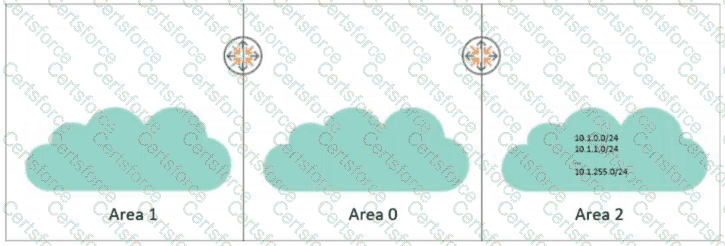
Configuring the Area of Origin: A fundamental rule of OSPF summarization is that the range command must be applied to the Area where the specific routes originate. In the exhibit, the /24 subnets (10.1.0.0/24 through 10.1.255.0/24) are located in Area 2. Therefore, the ABR must be configured under area 2.
AOS-CX Syntax: On HPE Aruba Networking CX switches, the command to summarize internal routes is area < AREA-ID > range < IP-ADDR/MASK > type inter-area.
The type inter-area keyword specifies that the ABR should take the internal routes from the specified area and advertise them as an Inter-Area (Type 3) summary to other connected areas (like the Backbone Area 0).
Analyzing the Options:
Option A and D: These are incorrect because they apply the range to Area 0. This would only work if the routes originated in Area 0 and you wanted to summarize them for Area 2.
Option B: This is incorrect because summary-only is not the standard keyword for OSPF summarization in the AOS-CX CLI. While similar concepts exist in other protocols (like BGP) or other vendors, AOS-CX uses type inter-area to define the summary behavior.
Option C (Correct): It correctly identifies Area 2 as the source and uses the proper AOS-CX syntax to generate a 10.1.0.0/16 summary route, which covers the entire 10.1.x.x range shown in the exhibit.


Submit