The term " Active " in BGP is one of the most misunderstood states. It sounds positive, but it actually indicates that the switch is " actively " trying to establish a TCP connection and failing.
eBGP Default Behavior: By default, External BGP (eBGP) expects neighbors to be directly connected. Because of this, eBGP packets are sent with a Time to Live (TTL) of 1.
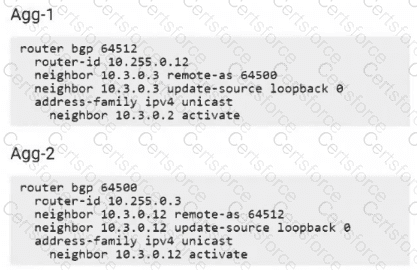
The Loopback Problem: In the exhibit, the switches are peering using their Loopback 0 addresses (update-source loopback 0). Even if the switches are physically connected, the Loopback interface is considered a " hop " away from the physical interface.
TTL Expiry: When Agg-1 sends a BGP packet to Agg-2 ' s loopback, the TTL of 1 expires before the packet can reach the logical loopback interface. This causes the TCP connection to fail, keeping the session in the Active state.
The Solution (eBGP Multihop): To fix this, you must configure ebgp-multihop (usually with a value of 2 or more). This increases the TTL, allowing the BGP packets to reach the loopback address.
Side Note on the Exhibit: If you look closely at Agg-1 ' s configuration, there is a typo: the neighbor is defined as 10.3.0.3 but the address-family activation is for 10.3.0.2. While this would also cause a failure, the core architectural concept being tested here regarding " Active " state and loopbacks is the TTL/Multihop requirement.


Submit