Comprehensive and Detailed Explanation
HPE Press guide context | PDF page 717 | HPE Press, Aruba Certified Associate – Campus Access Official Certification Study Guide
Technical Deep Dive — Reconstructed (Original Chat Text Not Recoverable)
Absorption and penetration loss weaken received RF signal strength. If the noise floor is relatively unchanged, this reduces signal-to-noise ratio and can force lower modulation/coding rates or retransmissions. Central cannot automatically eliminate building material loss, and channel bonding does not directly compensate for lower SNR.
The selected answer corresponds to B: Signal to Noise Ratio (SNR) decreases.. This matches the mechanism or management behavior described in the scenario rather than merely a related network feature.
Optimization should consider both immediate performance and its tradeoffs in RF capacity, airtime, reliability, security, and operational overhead.
Use measurements rather than assumptions: compare the RF or switch metrics before and after making a controlled change.
For an administrator preparing for the associate certification, the key distinction is the precise protocol or Central workflow involved. Similar-sounding features often operate at different OSI layers or management stages.
The wrong choices may describe real technologies, but they perform different functions, apply to another layer, or omit a required prerequisite. Select the answer that resolves the exact scenario, not a nearby administrative task.
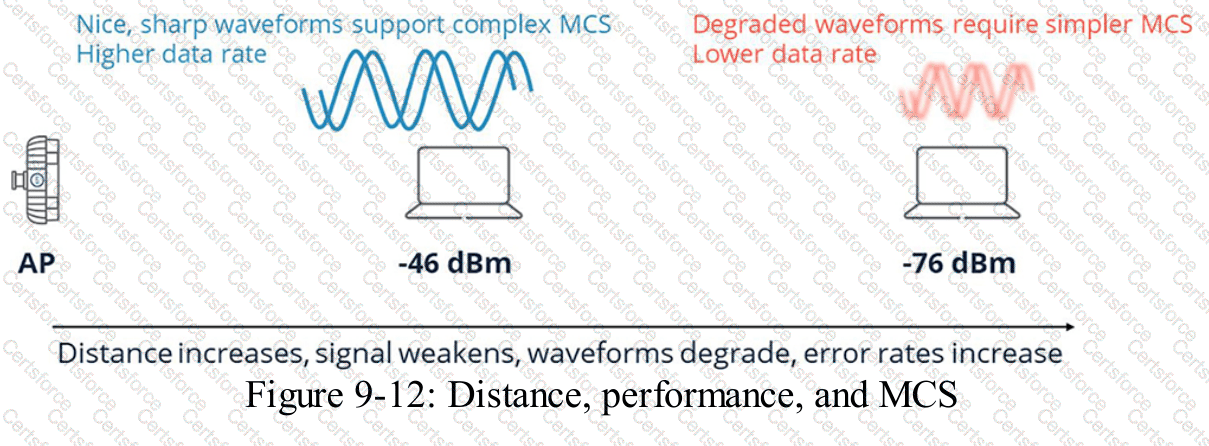
HPE Press study-guide figure / related learning illustration · Fig 9-12 Attenuation


Submit