Comprehensive and Detailed Explanation
HPE Press guide context | PDF page 1000 | HPE Press, Aruba Certified Associate – Campus Access Official Certification Study Guide
Technical Deep Dive — Original Chat Wording
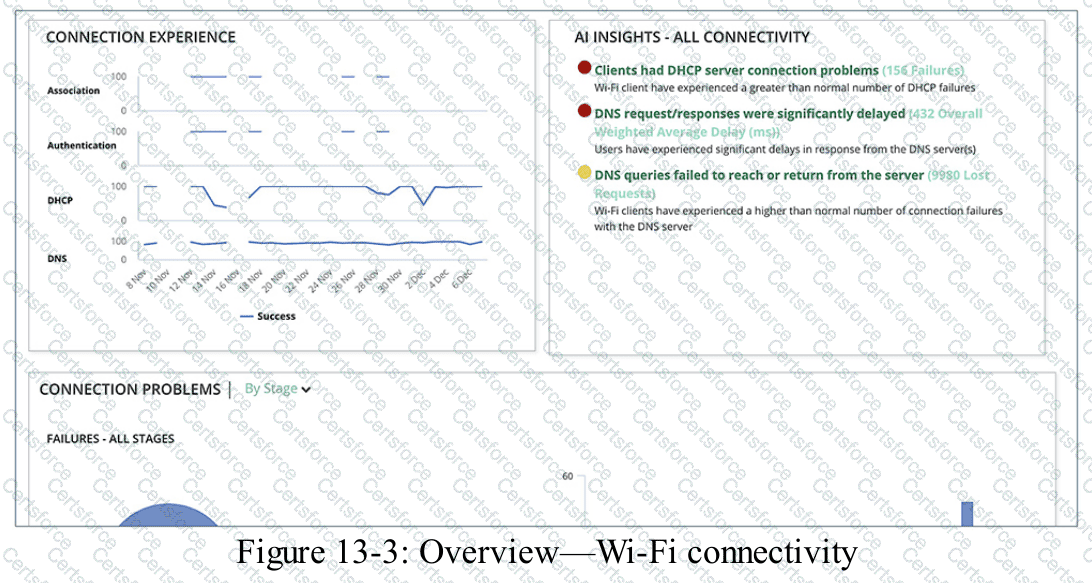
The Client Connectivity Metrics card provides detailed visibility into the different stages of the network onboarding process.
Instead of showing only whether a client eventually connects, the card identifies where the connection succeeds, fails, or experiences delays.
The process is divided into four important stages:
- Association: Determines whether the wireless client successfully associates with an access point.
- Authentication: Evaluates whether the client successfully completes the applicable network authentication process.
- DHCP: Verifies that the client obtains valid IP addressing information.
- DNS: Measures successful domain-name resolution.
For example, a client may associate successfully and complete authentication but fail to receive an IP address because the DHCP server is unavailable.
The card allows administrators to distinguish this situation from an authentication failure.
It also provides connectivity success rates, failure reasons, and information about delayed connection attempts.
Administrators can analyze results by individual clients or by total connection attempts.
These measurements are particularly useful for diagnosing intermittent wireless problems and understanding their impact on users.
Client operating systems, wireless signal quality, and assigned roles are relevant to other monitoring functions but are not the primary connectivity stages displayed in this card.
Therefore, Option C (Detailed connectivity steps such as association and authentication) is correct.
HPE Press study-guide figure / related learning illustration · Q196 Fig 13 3 Client Connectivity


Submit