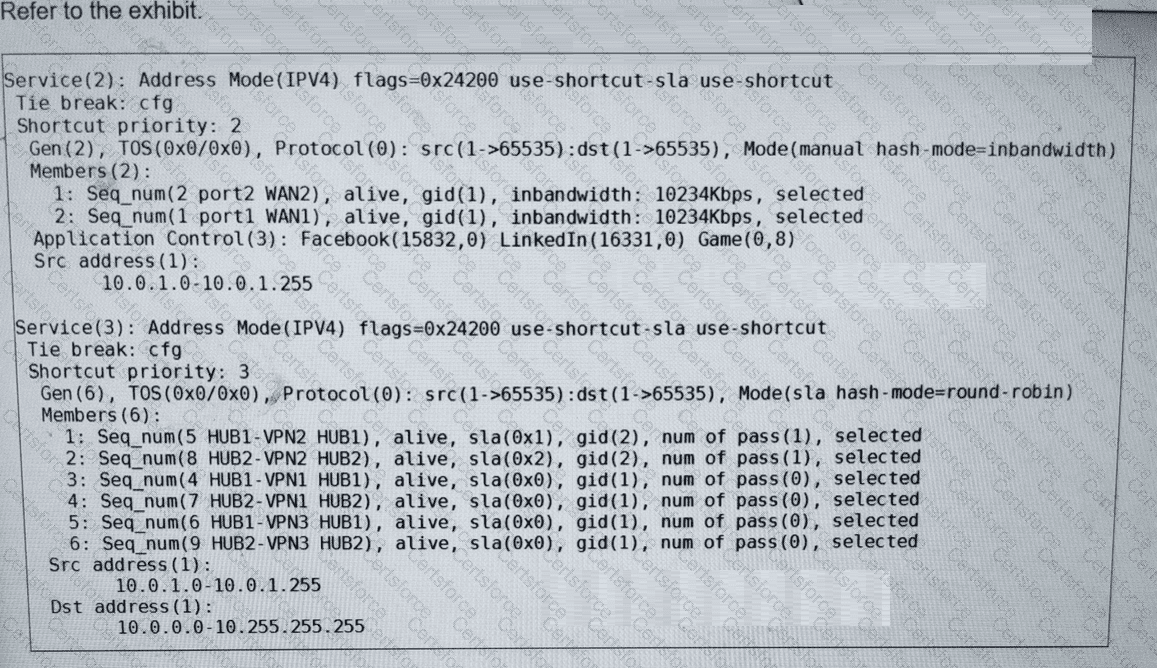
Refer to the exhibit. The administrator configured two SD-WAN rules to load balance the traffic. Which interfaces does FortiGate use to steer the traffic from 10.0.1.124 to 10.0.0.254? Choose one answer.
The exhibit shows the runtime details of two SD-WAN services (rules): Service(2) Service(3) Traffic from 10.0.1.124 to 10.0.0.254 matches Service(3) because the destination IP 10.0.0.254 falls within the destination range 10.0.0.0– 10.255.255.255. Within Service(3), the member list shows SLA results per interface: This indicates that, for Service(3), only HUB1-VPN2 and HUB2-VPN2 are currently meeting the SLA requirements (passing), and because the rule uses hash-mode=round-robin, FortiGate load-balances sessions across the passing members. Therefore, FortiGate will steer the traffic using HUB1-VPN2 or HUB2-VPN2, which corresponds to Option B. An operational review should distinguish the rule that matches the traffic from the interface that is ultimately selected. Valid forwarding also depends on destination route eligibility, current member state and the applicable SLA or quality-selection algorithm. A diagnostic showing configured members alone is not conclusive evidence that all those members will carry a particular flow. When troubleshooting, correlate the configured SD-WAN service with diagnose sys sdwan service4, the live session entry and the routing table. An application signature, an IP route and a health-check result describe different decision stages; treating them as interchangeable can produce incorrect conclusions about the egress interface.
Verification qualification: SLA eligibility and routing-table reachability need confirmation; the two-member outcome depends on those conditions.
Chosen Answer:
This is a voting comment (?). You can switch to a simple comment. It is better to Upvote an existing comment if you don't have anything to add.


Submit