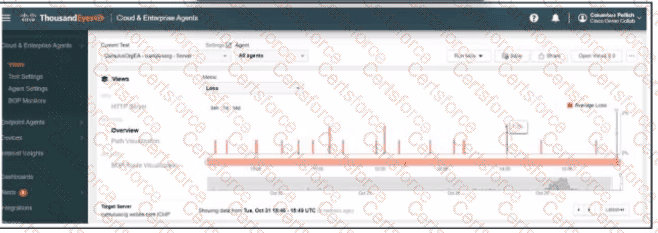
Considering the observed network behavior and the information in the exhibits, which action would be the most appropriate next step for the network administrator to take?
A.
Contact the internal network team to investigate potential misconfigurations on the local routers
B.
Reach out to the Internet Service Provider (ISP) to report the suspected BGP hijacking incident
C.
Implement traffic filtering rules on the firewall to block traffic originating from AS 10297
D.
Restart the DNS server to refresh its cache and potentially resolve the observed issue
TheDesigning and Implementing Enterprise Network Assurance (300-445 ENNA)framework emphasizes that the goal of internet intelligence is to enable rapid and accurate escalation to the party responsible for a service degradation. Based on the evidence of a BGP Hijack identified in the previous question, the issue is occurring entirely within the public internet ecosystem.
The most appropriate next step is toreach out to the Internet Service Provider (ISP) to report the suspected BGP hijacking incident(Option B). Since the traffic is being misdirected by an external Autonomous System (AS 10297) before it reaches the intended destination (AS 16509), the fix must occur at the routing policy level of the major transit providers. The network administrator should provide the ISP with the ThousandEyes "Share Link" or screenshots showing the path change and the unauthorized AS announcement, as this data serves as proof to accelerate the ISP's mitigation efforts, such as implementing prefix filters or contacting the offending network.
Other options are ineffective for this specific scenario:
Option A:The path visualization shows that traffic is successfully leaving the local network and reaching the public internet; the problem is many hops away from the internal routers.
Option C:Blocking trafficfromAS 10297 does not solve the problem of your traffic beingattractedto it. The hijack affects how the rest of the world (including your ISP) sees the route to your destination.
Option D:DNS is not the issue; the agent successfully resolved the hostname to the correct IP, but the BGP layer misdirected the packets at the routing level.
By identifying the issue as an external routing event, the administrator avoids wasting internal resources and directly triggers the necessary external remediation.
Contribute your Thoughts:
Chosen Answer:
This is a voting comment (?). You can switch to a simple comment. It is better to Upvote an existing comment if you don't have anything to add.
Submit