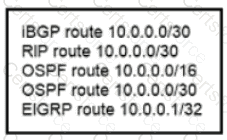
A router installs the best route by applying two major rules: longest prefix match and administrative distance. Prefix length is considered first when routes describe different destination scopes; the more specific prefix wins for destinations inside that range. When routes have the same prefix length but come from different routing sources, the route with the lower administrative distance is preferred. In the answer set, the OSPF route to 10.0.0.0/30 is chosen over competing routes to the same /30 because OSPF has a better administrative distance than RIP and iBGP. The EIGRP host route to 10.0.0.1/32 is also installed because it is a more specific route to that single host. Cisco CCNA 200-301 v1.1 IP Connectivity requires engineers to interpret routing tables using these exact rules. The OSPF /16 is broader and does not replace a more specific /30 for matching destinations. The route table can contain both a network route and a host route when their prefixes differ.
Contribute your Thoughts:
Chosen Answer:
This is a voting comment (?). You can switch to a simple comment. It is better to Upvote an existing comment if you don't have anything to add.


Submit