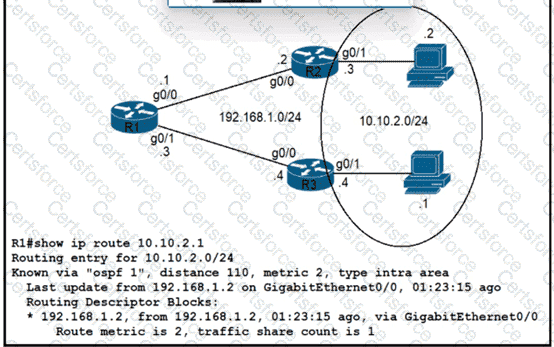
Refer to the exhibit. After the configuration is applied, the two routers fail to establish an OSPF neighbor relationship. what is the reason for the problem?
A.
The OSPF router IDs are mismatched.
B.
Router2 is using the default helto timer.
C.
The network statement on Router1 is misconfigured.
Router2 is using the default helto timer.. OSPF decisions depend on router IDs, area membership, matching timers, network type, interface state, and cost calculation rather than arbitrary route preference. Cisco CCNA 200-301 v1.1 includes this topic under IP Connectivity, so the answer must be validated against normal Cisco device behavior and the operational wording of the scenario. The key is not simply recognizing a familiar acronym; it is identifying what the feature does, where it is configured, and what result it produces. Distractors that mention process IDs, unrelated metrics, or the wrong interface parameter do not satisfy OSPF neighbor or route-selection requirements. In a real network, selecting the wrong option would either leave the feature nonfunctional, create a forwarding or security gap, or send troubleshooting in the wrong direction. The selected answer is the only one that matches the stated requirement and the way Cisco switching, routing, services, security, wireless, or automation functions are expected to operate. This is why the verified answer remains the best technical choice for the question.
Contribute your Thoughts:
Chosen Answer:
This is a voting comment (?). You can switch to a simple comment. It is better to Upvote an existing comment if you don't have anything to add.
Submit