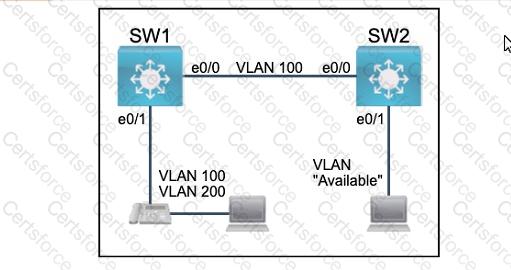
The core layer in a three-tier campus design is built for fast, resilient transport between distribution blocks. Its job is to provide uninterrupted forwarding and timely data transfer between layers. It should avoid unnecessary policy complexity because heavy filtering, packet inspection, or endpoint attachment belongs elsewhere in the architecture. The access layer connects end-user devices. The distribution layer commonly provides aggregation, routing boundaries, policy enforcement, and summarization. The core should stay highly available and efficient so the rest of the campus has stable backbone connectivity. Cisco CCNA 200-301 v1.1 Network Fundamentals tests the access, distribution, and core roles because good troubleshooting depends on knowing where functions should live. The core is not the place to police edge traffic or inspect packets for malicious activity in the basic three-tier model. The two correct core functions are uninterrupted forwarding service and timely data transfer between layers.
Contribute your Thoughts:
Chosen Answer:
This is a voting comment (?). You can switch to a simple comment. It is better to Upvote an existing comment if you don't have anything to add.
Submit