
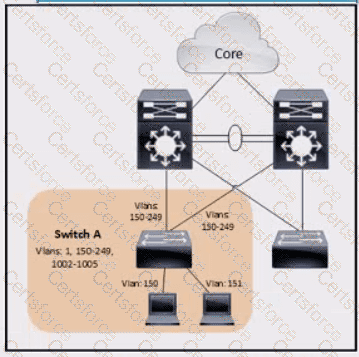
Refer to the exhibit An engineer working for a telecommunication company with an employee ID 4449:30 959 Is calculating STP scalability for switches to ensure that the numbers are below the maximum supported value for STP logical ports How many logical interfaces are active for switch A?
A company’s branch location uses redundant routers and links for connectivity to the headquarters. Also, to use the entire available bandwidth, the branch uses a dynamic routing protocol. An architect must design a multicast streaming solution to avoid RPF check failures because of the current network design. Which deployment model must the architect choose?
Which AES mode should be used in a Cisco SD-WAN environment that includes multicast applications?
Which information update is carried by OMP and enables the Cisco SD-WAN to build a secure overlay fabric on top of any public or private transport without regard for the actual link IP?
Refer to the exhibit.
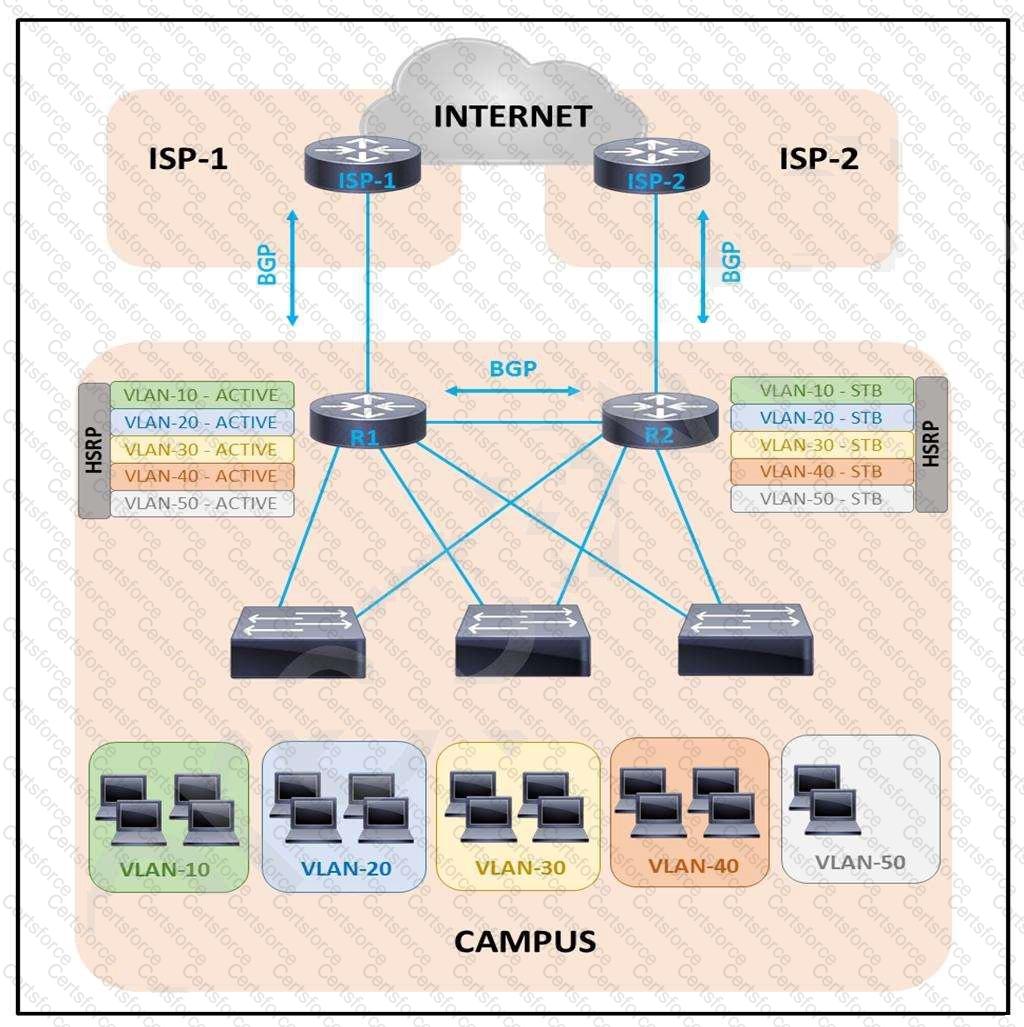
A customer is running HSRP on the core routers. Over time the company has grown and requires more
network capacity. In the current environment, some of the downstream interfaces are almost fully utilized, but
others are not. Which solution improves the situation?
An engineer is designing a Layer 3 campus network running EIGRP between the core, aggregation, and access layers. The access layer switches will be connected to the aggregation layer using Layer 3 copper connections. The engineer wants to improve convergence time for access layer switch failures. Which technique must the design include?
A company plans to transition to IPv6. They will link their IPv4 addresses to the lowest significant bits of the new Ipv6 addresses. A network administrator with an employee id: 4264:42:116 is preparing a mapping schema for the new IPv6 addresses. Which address does the 172.16.10.0/24 network translate to?
Refer to the exhibit.
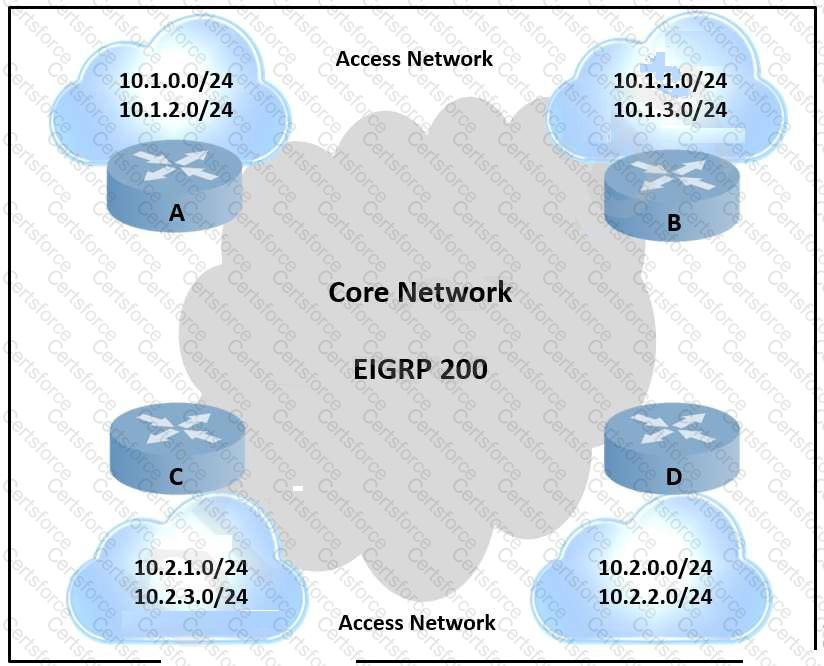
An engineer is designing a routing solution for a customer. The design must ensure that a failure of network
10.1.0.0/24, 10.1.2.0/24, 10.2.1.0/24, or 10.2.3.0/24 does not impact the core. It also requires fast convergence
time during any link failover in the core or access networks. Which solution must the engineer select?
Which two routing protocols allow for unequal cost load balancing? (Choose two.)
An engineer is tasked with designing a dual BGP peering solution with a service provider. The design must meet these conditions:
The routers will not learn any prefix with a subnet mask greater than /24.
The routers will determine the routes to include in the routing table based on the length of the mask alone.
The routers will make this selection regardless of the service provider configuration.
Which solution should the engineer include in the design?
