Month End Sale Limited Time 70% Discount Offer - Ends in 0d 00h 00m 00s - Coupon code: simple70

Pass the Adobe Adobe Commerce AD0-E722 Questions and answers with CertsForce

Viewing page 2 out of 2 pages
Viewing questions 11-20 out of questions
Questions # 11:

A third-party company needs to create an application that will integrate the Adobe Commerce system to get orders data for reporting. The integration needs access to the GET /Vl/orders endpoint. It will call this endpoint automatically every hour around the clock. The merchant wants the ability to restrict or extend access to resources as well as to revoke the access using Admin Panel.

Which type of authentication available in Adobe Commerce should be used and implemented in a third-party system for this integration?

Options:

A.

Use token-based authentication to obtain the Admin Token. The third-party system will utilize the REST endpoint using the admin username and password to get the Admin Token, which will be used as the Bearer Token to authorize.


B.

Use token-based authentication to obtain an integration Token, integration will be created and activated in the admin panel using default integration token settings to get access to the token, which will be used as the Bearer Token to authorize.


C.

Use OAuth-based authentication to provide access to system resources. Integration will be registered by the merchant in the admin panel with an OAuth handshake during activation. The third-party system should follow OAuth protocol to authorize.


Expert Solution
Questions # 12:

A single Adobe Commerce Cloud instance is set up with two websites (each with a single store view) with different domains.

• The default website is website_one, with store view store_one, and domain storeone. com.

• The second website is website_two, with store view store_two, and domain storetwo. com.

The magento-vars. php file is set up as follows to determine which website each request runs against:
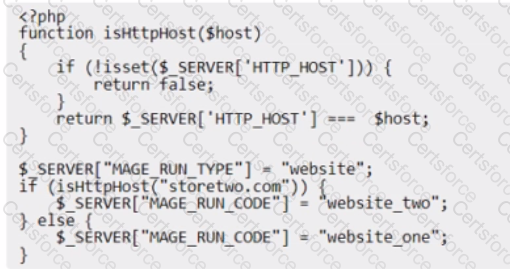
Question # 12

When testing a new GraphQL integration, all requests returned data relating to the default website, regardless of the domain. What is causing this issue?

Options:

A.

The magento-vars.php file is not processed for any GraphQL requests, so the default website is always processed.


B.

$_server["mage_run_cooe") needs to be setto store and *$_SERVER["MAGE_RUN_TYPE"] needs to be set to the store code instead.


C.

GraphQL requests are always run against the default store view unless a store header or store cookie is provided.


Expert Solution
Questions # 13:

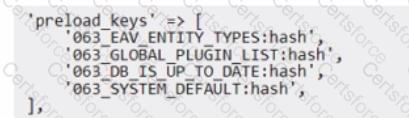
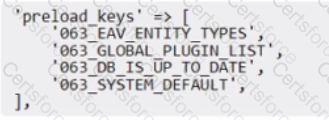
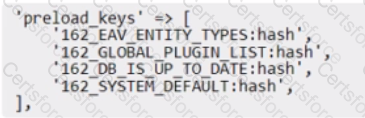
An Architect is configuring the preload.keys for Redis on an Adobe Commerce on-premise instance.

The Architect discovers that the following cache keys are loaded on each frontend request: EAV_ENTITY_TYPES, GLOBAL_PLUGIN_LIST, DB_IS_UP_TO_DATE, SYSTEM_DEFAULT.

• The id_prefix of the frontend => page_cache is set to 063_.

• The id_pref ix of frontend => default is set to 762_.

• The Architect has enabled and configured Redis L2 caching.

How should the preload.keys be configured?

A)
Question # 13

B)

Question # 13

C)

Question # 13

D)

Question # 13

Options:

A.

Option A


B.

Option B


C.

Option C


D.

Option D


Expert Solution
Questions # 14:

An Architect wants to create an Integration Test that does the following:

• Adds a product using a data fixture

• Executes $this->someLogic->execute($product) on the product

• Checks if the result is true.

$this->someLogic has the correct object assigned in the setup() method.

Product creation and the tested logic must be executed in the context of two different store views with IDs of 3 and 4, which have been created and are available for the test.

How should the Architect meet these requirements?

Options:

A.

Create two test classes with one test method each. Use the @magentoExecuteinstoreContext 3 and $MagentoExecuteinStoreContext 4 annotations on the class level.


B.

Create one test class with two test methods. Use the emagentostorecontext 3 annotation in one method and amagentostorecontext 4 in the other one.


C.

Create one test class with one test method. Use the \Magento\TestFramework\store\ExecuteinstoreContext class once in the fixture and another time in the test.


Expert Solution
Questions # 15:

A client has multiple warehouses where orders can be fulfilled. The cost of shipping goods from each warehouse varies by day, due to the number of workers available. The Architect needs to make sure that when an order is shipped, it is shipped from the lowest cost warehouse that is open.

How should this functionality be implemented?

Options:

A.

Create anew class as a preference for Magento\inventoryShipping\piugin\Sales\shipment\AssignSourceCodeToShipmentPlugin to set the lowest-cost warehouse on a shipment.


B.

Create a new class implementing Magento\invtntorysourceSelectionApi\Modei\sourceSelectioninterfacece. which returns open warehouses sorted by cost.


C.

Create an after plugin OnHagento\InventoryDistanceBasedSourceSelection\Hodel\Algorithms\DistanceBasedAlgorithto sortto Warehouse sources by cost


Expert Solution
Viewing page 2 out of 2 pages
Viewing questions 11-20 out of questions