
Black Friday Reward - Upto 80% off - Ends in 0d 00h 00m 00s - Coupon code: VIP80

Pass the Adobe Adobe Real-Time CDP AD0-E615 Questions and answers with CertsForce

Viewing page 2 out of 2 pages
Viewing questions 11-20 out of questions
Questions # 11:

A retailer is uploading a 25 GB CSV file for batch ingestion. The job completes with status "Partially Failed". Some records are visible in the dataset, but marketing reports are missing profiles.

Which next step would be taken to address this issue?

Options:

A.

Review the ingestion error diagnostics to identify failed records before reprocessing.


B.

Increase the dataset's merge policy priority to recover failed records.


C.

Enable streaming ingestion instead of batch ingestion to avoid file-level validation errors.


Expert Solution
Questions # 12:

An organization wants to export its profile data to an Amazon S3 destination. An Adobe Real-Time CDP Developer configures the destination for an incremental file export to Amazon S3. After 15 days, the Developer notices that some profiles that were updated in Adobe Real-Time CDP in the last three days have not been exported to Amazon S3.

What could be a reason that the updated profiles were not exported as a part of the incremental file export?

Options:

A.

A new identity field was added to the identity graph of profiles that is not included in the existing destination mapping.


B.

A new attribute field was added or removed from the profiles that is not included in the existing destination mapping.


C.

The profile qualified for a different segment due to the updates and therefore was not included for export.


Expert Solution
Questions # 13:

An Adobe Experience Platform Developer is modeling a schema for collecting data sent through Web SDK.

Which suggestion helps the Developer maintain data integrity when creating the schema?

Options:

A.

Mark a schema field as a mandatory primary identity for ingesting data via Web SDK.


B.

Avoid designating additional fields as primary identities for that schema other than identityMap .


C.

Use the _id field in ExperienceEvent schemas as an identity because it is meant for record uniqueness.


Expert Solution
Questions # 14:

A travel and hospitality company uses Adobe Target for experience personalization and optimization for users on their website, and Adobe Real-Time CDP to activate audiences to Adobe Target. With this setup, the leadership wants to stay compliant with the data privacy laws and enforce user consent policies across their tools.

Which configuration must be done within Adobe Real-Time CDP to exclude profiles from activation based on their consent?

Options:

A.

Create a Data governance policy which restricts profiles based on their consent to activation.


B.

Create a Consent data usage policy which restricts profiles based on their consent to activation.


C.

Update the segments activated to Adobe Target to exclude profiles based on their consent.


Expert Solution
Questions # 15:

A healthcare company ingests patient email addresses labeled with a data usage label restricting use for third-party advertising. A marketing user attempts to activate an audience containing these profiles to a paid social destination. The activation fails.

What action would a Developer take next?

Options:

A.

Remove the data usage label from the email field to allow activation.


B.

Create a new merge policy excluding the restricted dataset.


C.

Modify the destination configuration to override governance enforcement.


D.

Remove restricted fields from the destination mappings.


Expert Solution
Questions # 16:

An Adobe Real-Time CDP Developer is modeling a unified customer profile in Adobe Experience Platform for a retail brand.

There are three data sources for ingestion:

• E-commerce transactions (orderId, orderTotal, timestamp, customerEmail)

• Loyalty program data (loyaltyId, pointsBalance, customerEmail)

• In-store POS data (receiptId, storeLocation, purchaseAmount, loyaltyId)

How should the Developer design the data model in Adobe Experience Platform for this use case?

Options:

A.

Create separate schemas for each data source, map them to custom XDM classes, and autogenerate identifiers.


B.

Create separate schemas for each data source, map them to appropriate XDM classes, and use identity fields to stitch profiles.


C.

Create a single schema containing all fields from e-commerce, loyalty, and POS systems to simplify ingestion and avoid schema relationships.


Expert Solution
Questions # 17:

An organization wants to target its users who have signed up to its newsletter and made a purchase in the last 14 days.

What would be an appropriate way to create this audience segment?
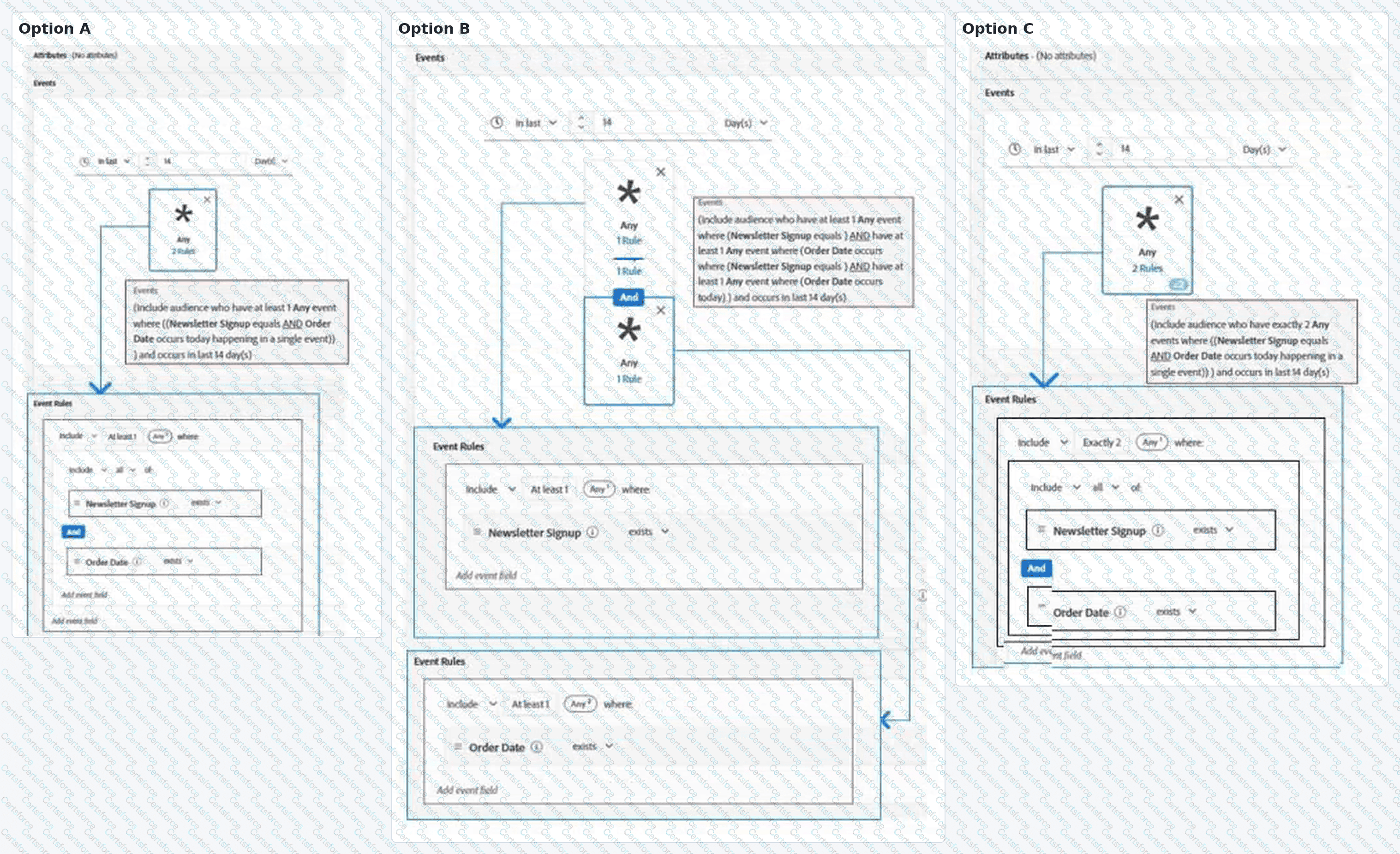
Question # 17

Options:

A.

Configure a single event container with at least one event containing both the Newsletter Signup AND Order Date conditions within the last 14 days.


B.

Configure two separate event containers connected using AND, with at least one Newsletter Signup event and at least one Order Date event within the last 14 days.


C.

Configure a single event container requiring exactly two events containing both the Newsletter Signup AND Order Date conditions within the last 14 days.


Expert Solution
Questions # 18:

What will be the impact on historical data if a field is marked as required post-data ingestion?

Options:

A.

Historical records with null value for the field will still reflect null as value.


B.

Historical records with null value for the field will not be processed by the downstream Adobe Experience Platform services.


C.

Historical records with null value for the field will be deleted from the dataset.


Expert Solution
Viewing page 2 out of 2 pages
Viewing questions 11-20 out of questions