New Year Sale Limited Time 70% Discount Offer - Ends in 0d 00h 00m 00s - Coupon code: simple70

Pass the Oracle MySQL Database Administration 1z0-888 Questions and answers with CertsForce

Viewing page 1 out of 4 pages
Viewing questions 1-10 out of questions
Questions # 1:

Which statement describes how the relay log works?

Options:

A.

when a slave receives a change from the master, it is processed first, and then recorded in the relay log.


B.

It maintains a record of available master binary logs and the current executed log position.


C.

It stores changes on the master, and relays them to the slave.


D.

When a slave receives a change from the master, it is recorded in the relay log first and processed later.


Expert Solution
Questions # 2:

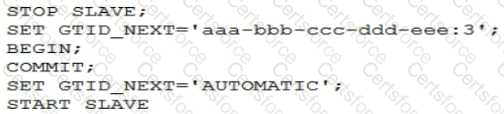
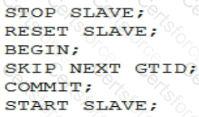
You are using GTIDS in replication. You need to skip a transaction with the GTID of aaa-bbb-ccc-ddd-eee:3 on a slave.

Which procedure would you execute from a MySQL prompt?

Options:

A.

1z0-888 Question 2 Option 1


B.

2


C.

2


D.

2


Expert Solution
Questions # 3:

Which three options are most likely to be changed for production form their default values? (Choose three.)

Options:

A.

innodb_buffer_pool_size


B.

max_connections


C.

join_buffer_size


D.

character_set_system


E.

innodb_log_file_size


F.

max_user_connections


G.

port


Expert Solution
Questions # 4:

Which two capabilities are granted with the SUPER privilege?

Options:

A.

allowing change of the server runtime configuration


B.

allowing a client to shut down the server


C.

allowing client accounts to take over the account of another user


D.

allowing a client to kill other client connections


Expert Solution
Questions # 5:

Which two are considered good security practices when using passwords? (Choose two.)

Options:

A.

Use one-way encryption for storage of passwords.


B.

Store passwords external to the database.


C.

Choose short passwords to save on storage space.


D.

Use simple keyboard actions that give mixed letters.


E.

Do not use dictionary-based words.


Expert Solution
Questions # 6:

How does the InnoDB storage engine handle deadlocks when they are detected?

Options:

A.

Both the affected transactions will be rolled back.


B.

The affected transactions wait for innodb_lock_wait_timeout seconds, and then roll back.


C.

One of the affected transactions will be rolled back, the other is allowed to proceed.


D.

The transaction isolation level determines which transaction is rolled back.


E.

The innodb_locks_unsafe_for_binlog setting determines which transaction is rolled back.


Expert Solution
Questions # 7:

Which two statements are true regarding the creating of new MySQL physical and logical backups? (Choose two.)

Options:

A.

Physical backups can be used to recover from data corruption.


B.

Logical backups are human-readable whereas physical backups are not.


C.

Logical backups are always larger than physical backups.


D.

Physical backups are usually slower than text backups.


E.

Physical backups are usually faster than text backups.


Expert Solution
Questions # 8:

Which MySQL utility program should you use to process and sort the Slow Query Log based on query time or average query time?

Options:

A.

mysqldumpslow


B.

mysqldump


C.

mysqlaccess


D.

mysqlshow


E.

mysqlslow


Expert Solution
Questions # 9:

The Performance Schema includes these tables related to status variables:
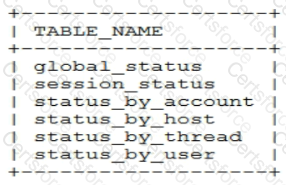
Question # 9

Which two facts are true about these tables? (Choose two.)

Options:

A.

The variable values in global_status are the sum of those in status_by_thread grouped by the variable name.


B.

All these tables have the same number of rows.


C.

The global_status table is equivalent to the SHOW GLOBAL STATUS statement.


D.

The variable values in status_by_account are the sum of those in status_by_host and status_by_user grouped by the variable name.


E.

The session_status table is equivalent to status_by_thread for the current thread.


Expert Solution
Questions # 10:

Examine the mysqldumpslow output:

Question # 10

Which two options could explain the slow query? (Choose two.)

Options:

A.

There is network congestion between client and server.


B.

No index has been defined on the filtered column.


C.

There are 108 queries still being executed.


D.

A table lock is causing delays.


E.

A full table scan is being used.


Expert Solution
Viewing page 1 out of 4 pages
Viewing questions 1-10 out of questions