
Manage Chart of Accounts Structure and Instance
Scenario
Your client is implementing Oracle Fusion Cloud Financials. The decision is to have a 5-segment Chart of Accounts: Company, Cost Center, Account, Product, and Intercompany. You are working in
the General Ledger team and will be responsible for creating the Chart of Accounts Structure and Instance for the Chart of Accounts.
Task 1
Create a Chart of Accounts Structure and Instance for the following Chart of Accounts:
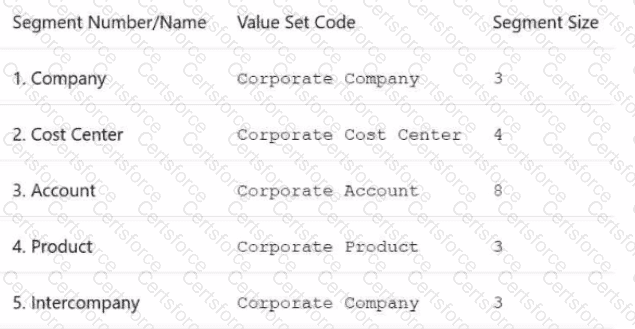
Note:
· Prefix all your setups with 07, where 07 is your candidate ID
· There is one balancing segment.
· Choose the appropriate segment labels.
. For the purpose of this test there is no need to deploy the flexfield.
. Valid code combinations should be added to the Code Combination table automatically.
· Shorthand aliases will not be implemented.
. Accept the defaults for the instance segments.
Task 3
Manage Chart of Accounts Mappings
Scenario
Your client needs to consolidate their UK Ledger to the Canadian parent ledger. Each Chart of Accounts
has the following segments:
Company-LoB-Account-Cost Center-Product-Intercompany
Know that the Company, LoB, Product, and Intercompany segments share the same value sets.
Create a Chart of Accounts mappings to map UK Chart of Accounts to CA Chart of Accounts that meets the following specifications:
Cost Center Mapping
. Balance Sheet (0 and 000) should be mapped to
Balance Sheet
. All other cost centers should be mapped to 610
Account Mapping
. Asset accounts (in the 1000 range) should be
mapped to account 11101
. Liability accounts (in the 2000 range) should be
mapped to account 22100
. Equity accounts (in the 3000 range) should be
mapped to account 34000
. Revenue accounts (in the 4000 range) should be
mapped to account 42000
. Expense accounts (from 5000 onwards) should be
mapped to account 51100
Note:
· Do not use conditions based on parents.
. Treat any account after the 5000 range as an expense.
· Ensure all maps are numeric only.
· When creating your mapping rules for each segment
please allow for existing and future segment values
Challenge 2
Manage Shorthand Aliases
Scenario
Your client intends to utilize the Shorthand Alias feature and would like to see how the aliases will appear when entering transactions.
Task 2
Create a shorthand alias for the US Chart of Accounts to record Revenue Domestic for Supremo Fitness, Line of Business 2, and US Operations Cost Center.
Note:
. Prefix your alias name with 07, where 07 is
your exam ID.
. There is no Product or Intercompany
impact.
Your UK operation has a requirement to maintain its ledger balances in USD to facilitate reporting to the parent company. A balance-level reporting currency has been created and linked to the primary ledger.
How are balances transferred to the reporting currency?
Your customer uses Financials Cloud, Projects, Inventory, and SCM.
Which two statements are true regarding intercompany accounting for these products? (Choose two.)
When creating your financial statements, you want a chart such as a bar graph to be included in the report output. Which two reporting tools allow you to achieve this?
You have three ledgers that use the same chart of accounts with one intercompany payable and one intercompany receivable account. The chart of accounts also has an intercompany segment. Each ledger has one legal entity assigned to it and each legal entity is associated with one balancing segment value.
At what level should you define the default intercompany balancing rule?
After completing a business requirement mapping session, it has been decided that only single Currency Journals will be entered for this Company.
To achieve this requirement, on which two objects should you enable “Limit a Journal to a Single Currency”? (Choose two.)
You want to automatically post journal batches imported from subledger sources to prevent accidental edits or deletions of the subledger sources journals, which could cause an out-of-balance situation between your subledgers and general ledger.
Which two aspects should you consider when defining your AutoPost Criteria?
Which two statements are true regarding the export/import of reports?
