Which of the following are signs of a complete airway obstruction? Select the two answer options that are correct.
A 44-year-old patient is unresponsive, and an EMT checks for a pulse prior to applying an AED. Which of the following shockable rhythms, ventricular fibrillation or ventricular tachycardia, if either, may still produce a pulse in this patient?
When treating a patient suspected of having tuberculosis, you should
A 76-year-old patient has behavioral changes that began this morning. The patient is also having trouble ambulating and speaking. Which of the following conditions should the EMT suspect? Select the two answer options that are correct.
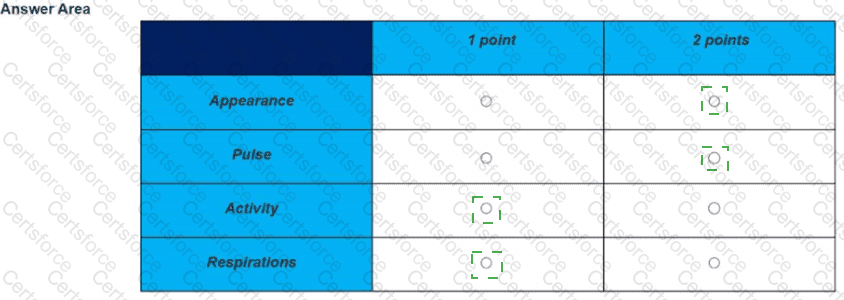
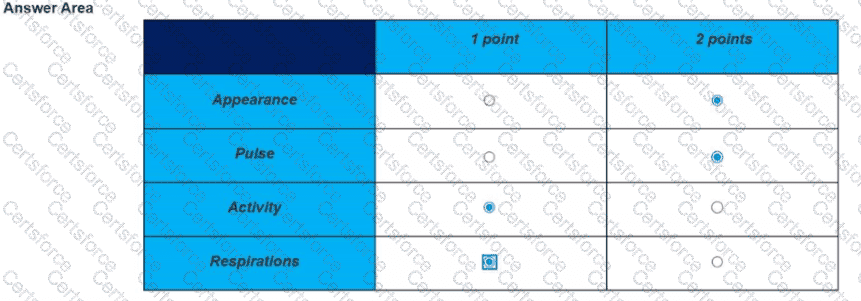
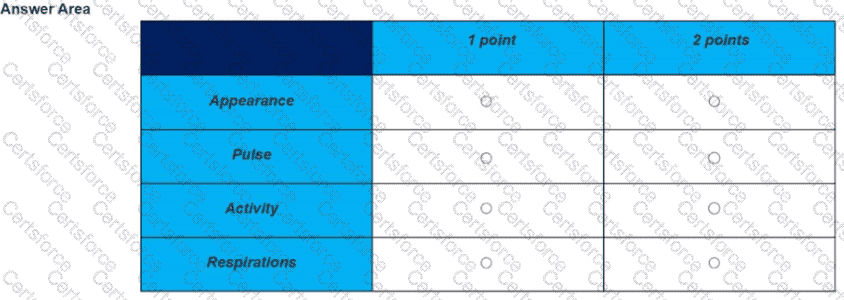
An EMT has just assisted with the delivery of a newborn. At the five-minute mark, the neonate is completely pink with a pulse of 108/min. The neonate has some flexion of their extremities, but the breathing is still slow. How should the EMT score the following categories of the APGAR scale? Select the correct value for each sign.
An 18-year-old patient is 40 weeks pregnant, and delivery is imminent. Which of the following actions should the EMT anticipate performing for the newborn? Select the three answer options that are correct.
If a deep vein thrombosis breaks free and enters the lungs, will it likely lodge in the pulmonary artery or the pulmonary vein, and what pathology would occur?
A 27-year-old patient is under arrest and in handcuffs after an altercation with police. The patient has a swollen left wrist that is tender to the touch. There is no deformity to the wrist, and distal pulses are present. The EMT is considering the following transport options:
• Option 1: Transport the patient in the ambulance, handcuffed, with the key-holding officer following the ambulance in a police car.
• Option 2: Transport the patient in the ambulance, but exchange the handcuffs for locking leather restraints to which the EMT has a key.
Which of these options should the EMT choose, if either?
A 1-year-old patient has meningitis. Which of the following signs and symptoms should the EMT expect to find? Select the three answer options that are correct.
You have achieved ROSC in a 77-year-old female. She remains unresponsive and her vital signs are BP 94/58, P 82, and R 18. In what position should she be placed?