You have a Fabric warehouse named Warehousel that contains a table named Table! Tablel contains customer data.
You need to implement row-level security (RLS) for Tablel. The solution must ensure that users can see only their respective data.
Which two objects should you create? Each correct answer presents part of the solution.
NOTE: Each correct selection is worth one point.
You have a Fabric tenant that contains customer churn data stored as Parquet files in OneLake. The data contains details about customer demographics and product usage.
You create a Fabric notebook to read the data into a Spark DataFrame. You then create column charts in the notebook that show the distribution of retained customers as compared to lost customers based on geography, the number of products purchased, age. and customer tenure.
Which type of analytics are you performing?
You have a Fabric tenant that contains two workspaces named Woritspace1 and Workspace2. Workspace1 contains a lakehouse named Lakehouse1. Workspace2 contains a lakehouse named Lakehouse2. Lakehouse! contains a table named dbo.Sales. Lakehouse2 contains a table named dbo.Customers.
You need to ensure that you can write queries that reference both dbo.Sales and dbo.Customers in the same SQL query without making additional copies of the tables.
What should you use?
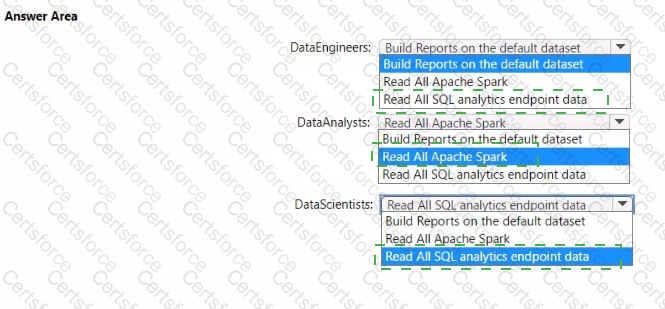
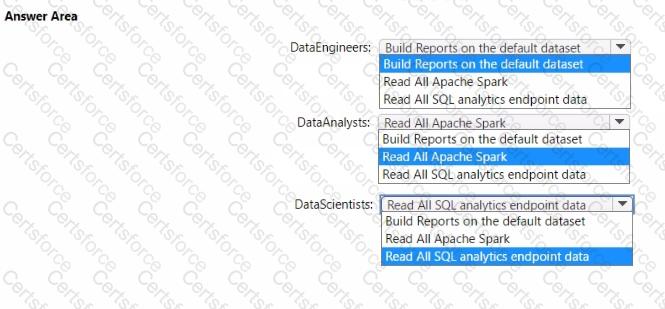
You to need assign permissions for the data store in the AnalyticsPOC workspace. The solution must meet the security requirements.
Which additional permissions should you assign when you share the data store? To answer, select the appropriate options in the answer area.
NOTE: Each correct selection is worth one point.
Which type of data store should you recommend in the AnalyticsPOC workspace?
You are the administrator of a Fabric workspace that contains a lakehouse named Lakehouse1. Lakehouse1 contains the following tables:
• Table1: A Delta table created by using a shortcut
• Table2: An external table created by using Spark
• Table3: A managed table
You plan to connect to Lakehouse1 by using its SQL endpoint. What will you be able to do after connecting to Lakehouse1?
You have a Microsoft Power Bl project that contains a semantic model. You plan to use Azure DevOps for version control.
You need to modify the .gitignore file to prevent the data values from the data sources from being pushed to the repository. Which file should you reference?
You have a Fabric tenant that contains a semantic model. The model uses Direct Lake mode.
You suspect that some DAX queries load unnecessary columns into memory.
You need to identify the frequently used columns that are loaded into memory.
What are two ways to achieve the goal? Each correct answer presents a complete solution.
NOTE: Each correct answer is worth one point.
You need to implement the date dimension in the data store. The solution must meet the technical requirements.
What are two ways to achieve the goal? Each correct answer presents a complete solution.
NOTE: Each correct selection is worth one point.
You have an Azure SQL database named DB1 and a Fabric workspace named Workspace1. Workspace 1 contains a lakehouse named LH1 and a Dataflow Gen2 named Dataflow1. Dataflow1 includes a query named Query1 that loads data from DB1. applies transformations to the data, and then filters the data.
You discover that Query1 loads all the data before applying the transformations.
You need to ensure that Query1 uses query folding.
What should you do?