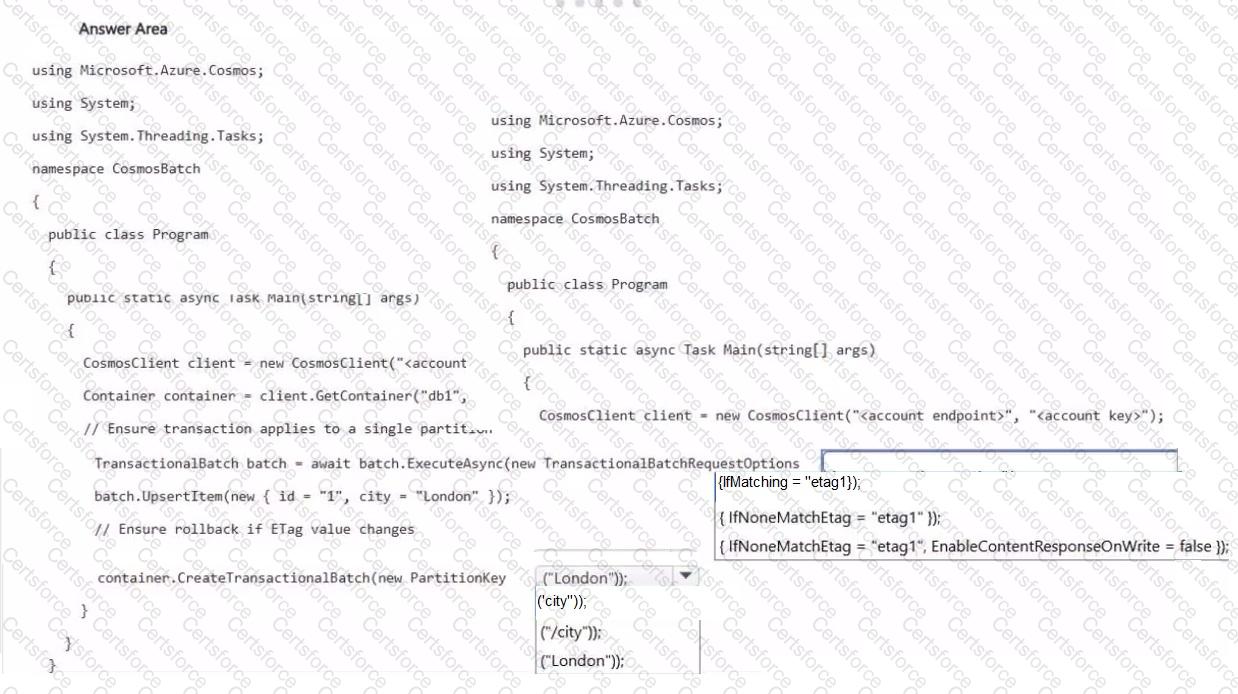
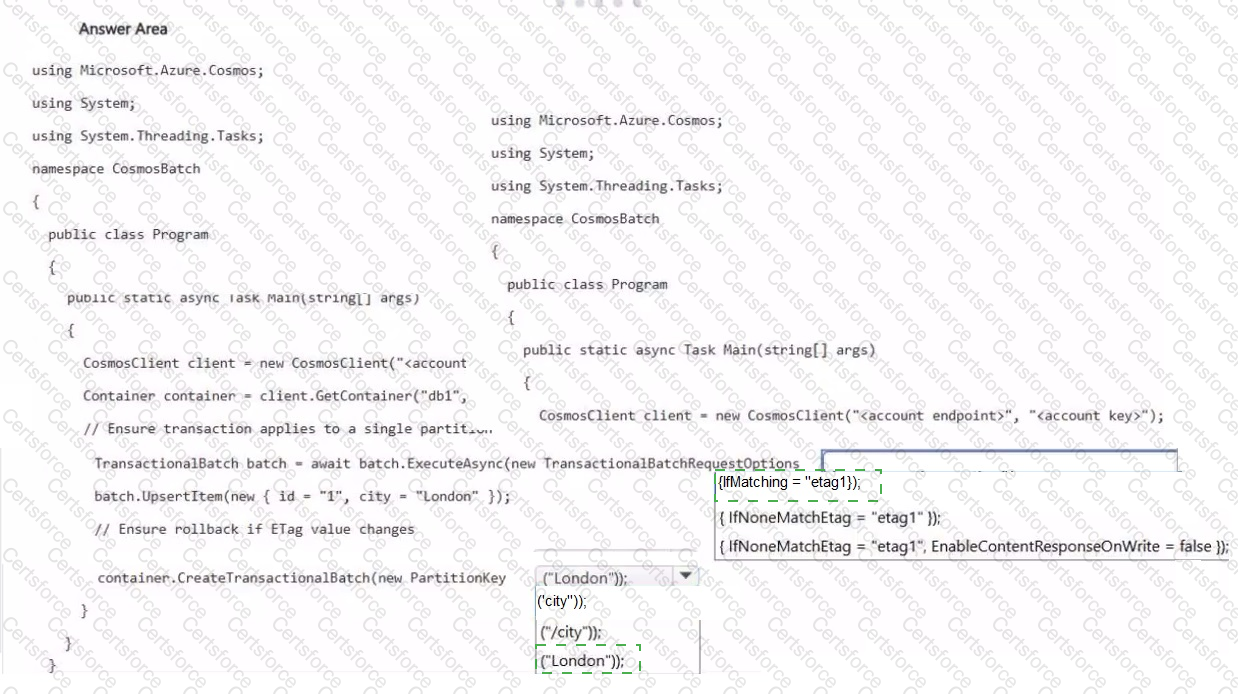
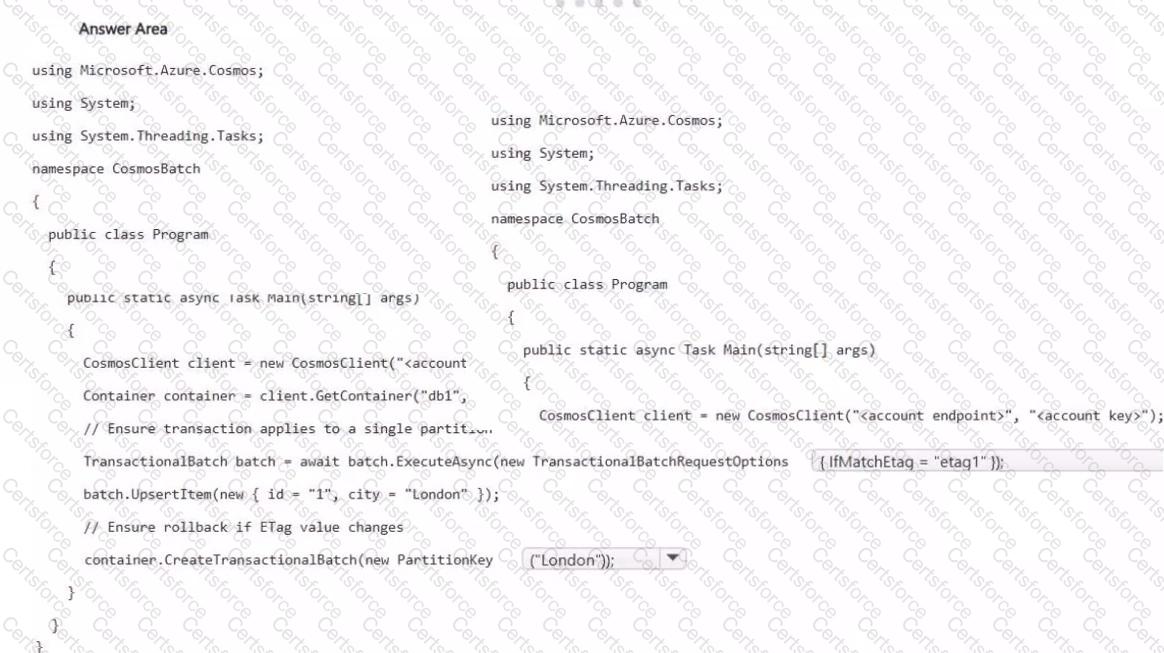
You have an Azure Cosmos DB for NoSQL database named DB1 that hosts a container named Contained. The partition key for Container! is /city.
You are developing a cloud-native app named App1 that will store customer information in DB1. App1 will perform transactional batch operations to update the items in Contained.
You need to configure App1 to meet the following requirements:
• Ensure that batch operations are rolled back if an item ' s ETag value has changed since the value was last read.
• Ensure that all operations in the batch apply to a single partition key value.
How should you complete the C# code? To answer, select the appropriate options in the answer area.
NOTE: Each correct selection is worth one point.
You have a database in an Azure Cosmos DB Core (SQL) API account.
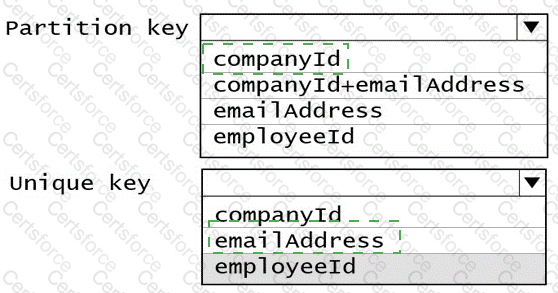
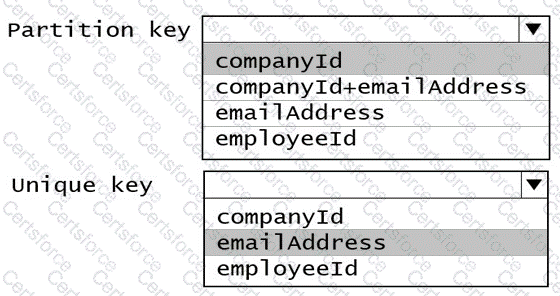
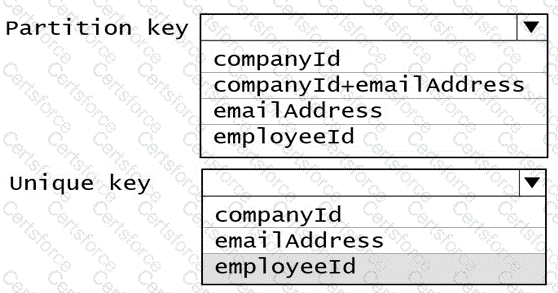
You plan to create a container that will store employee data for 5,000 small businesses. Each business will have up to 25 employees. Each employee item will have an emailAddress value.
You need to ensure that the emailAddress value for each employee within the same company is unique.
To what should you set the partition key and the unique key? To answer, select the appropriate options in the answer area.
NOTE: Each correct selection is worth one point.
You have a global ecommerce application that stores data in an Azure Cosmos OB for NoSQL account. The account is contoured for multi-region writes.
You need to create a stored procedure for a custom conflict resolution policy for a new container. In the event of a conflict caused by a deletion the deletion must always take priority.
Which parameter should you check m the stored procedure function?
Note: This question is part of a series of questions that present the same scenario. Each question in the series contains a unique solution that might meet the stated goals. Some question sets might have more than one correct solution, while others might not have a correct solution.
After you answer a question in this section, you will NOT be able to return to it. As a result1 these questions will not appear in the review screen.
You have a database in an Azure Cosmos DB for NoSQL account that is configured for multi-region writes.
You need to use the Azure Cosmos OB SDK to implement the conflict resolution policy for a container. The solution must ensure that any conflicts are sent to the conflicts feed.
Solution: You set ConflictResolutionMode to Laswriterwins and you use the default settings for the policy.
Does this meet the goal?
You have an Azure Cosmos OB for NoSQL account configured for global distribution across four regions. At connection time, the SQL SDK needs to identify the optimal endpoint for reading and writing. Which two factors can influence the SDK? Each correct answer presents a complete solution NOTE- Each correct selection is worth one point.
You have an Azure subscription that contains an Azure Cosmos DB for NoSQL account
You need to write a SQL query that will return multiple items. The solution must meet the following requirements:
• For each item returned, include the current Coordinated Universal Time (UTC) date and time, formatted as an ISO 8601 string.
• Minimize development effort.
What should you use?
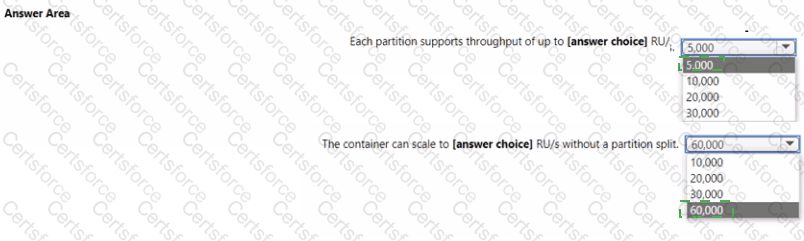
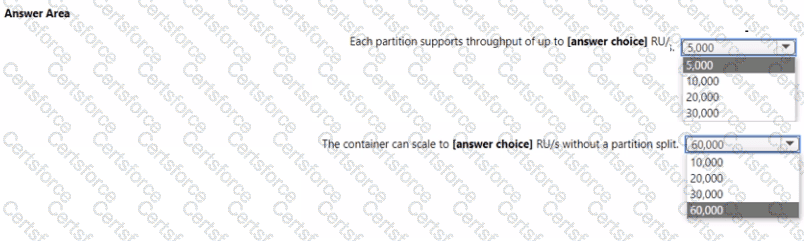
You have a container in an Azure Cosmos DB for NoSQL account. The database that has a manual throughput of 30,000 request units per second (RU/s). The current consumption details are shewn in the following chart.
Normalized RU Consumption (%) By PartitionKeyRangeID


Use the drop-down menus to select the answer choice that answers each question based on the information presented in the graphic. NOTE: Each correct selection is worth one point.
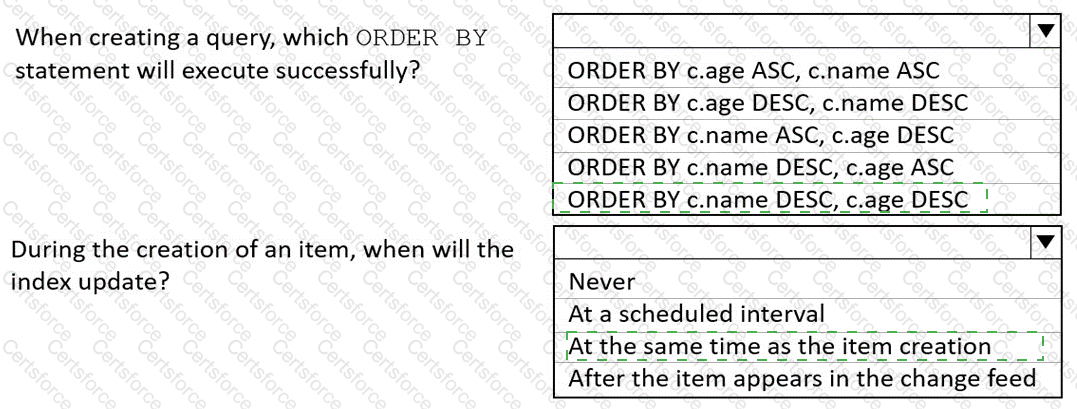
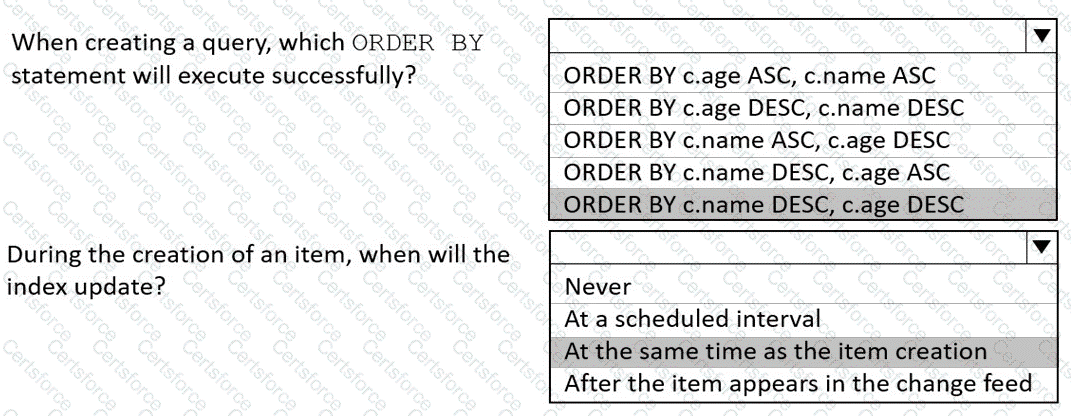
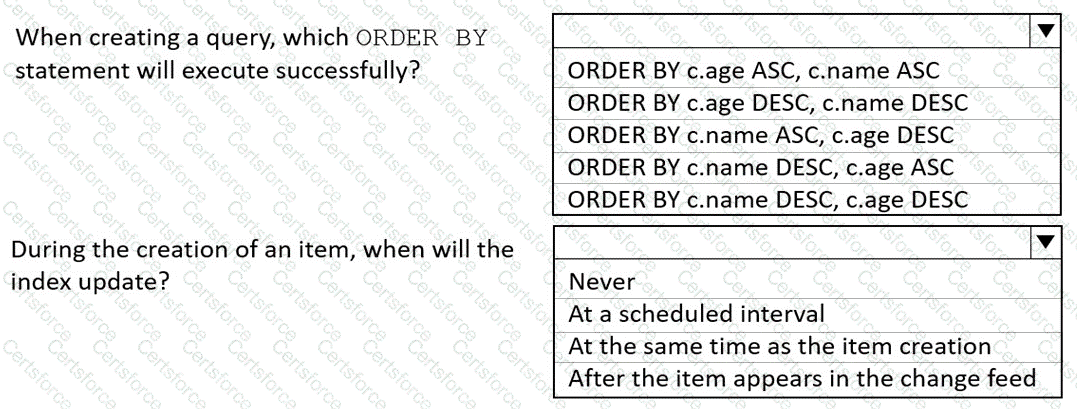
You have the indexing policy shown in the following exhibit.
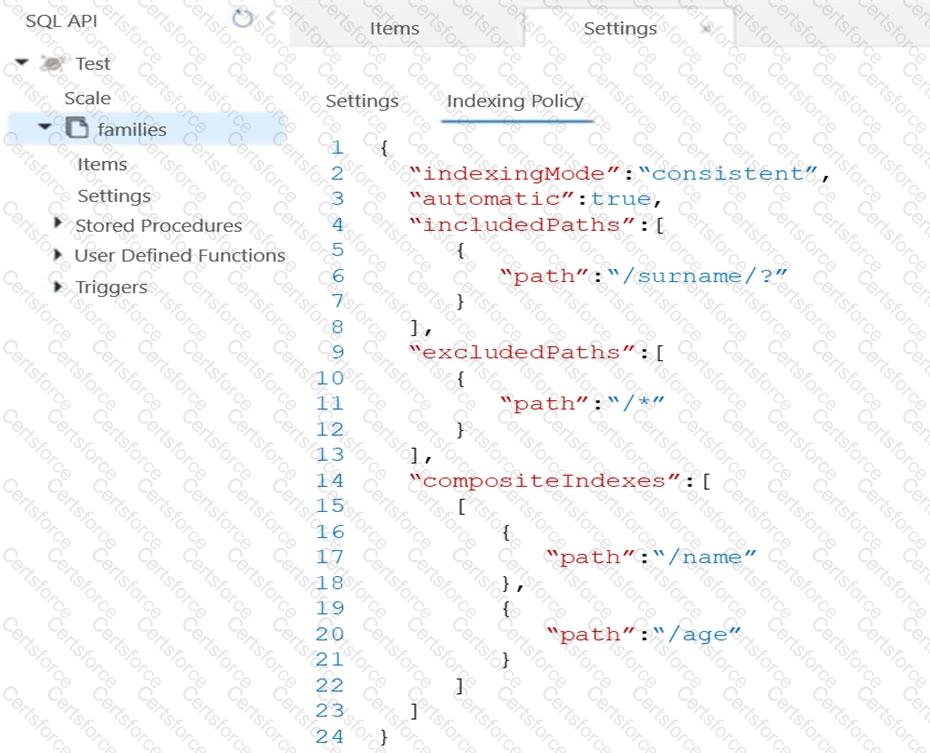
Use the drop-down menus to select the answer choice that answers each question based on the information presented in the graphic.
NOTE: Each correct selection is worth one point.
You have an Azure Cosmos DB for NoSQL database named db1 that writes to multiple Azure regions. You need to test the performance of db1 in the secondary region. Which command should you run first?
You have an Azure Cosmos DB account that hosts a single container named Container1. Container1 contains items that include two properties named Tenantld and Userld. Container1 has logical partitions based on the Tenantld property.
You need to configure subpartitioning for Container1 based on the Userld property. The solution must maximize data availability.
What should you do first?
 C:\Users\Waqas Shahid\Desktop\Mudassir\Untitled.jpg