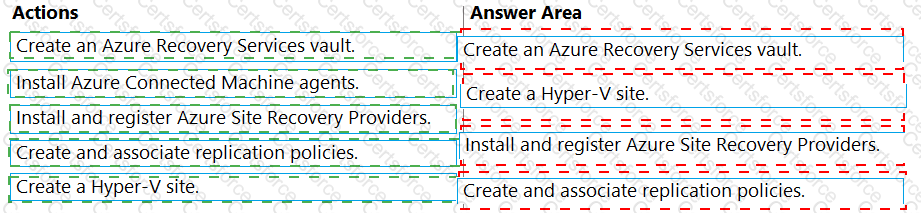
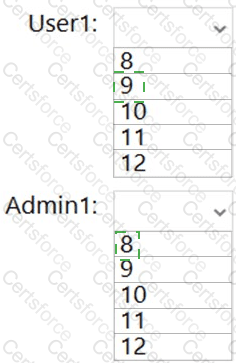
You plan to deploy the Azure Monitor agent to 100 on-premises servers that run Windows Server.
Which parameters should you provide when you install the agent?
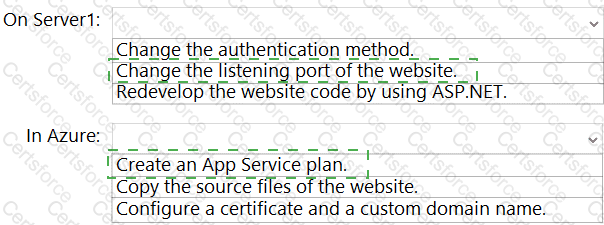
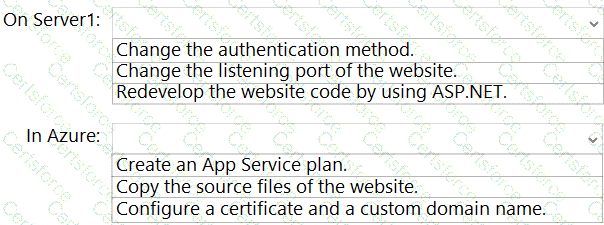
You have a server that runs Windows Server and has the Web Server (IIS) server role installed. Server1 hosts a single website that has the following configurations:
Is accessible by using a URL of https://www.contoso.com:8443 and has an SSL certificate that was issued by a third-party certification authority (CA) in the Microsoft Trusted Root Program
Uses anonymous authentication
Was developed by using PHP
You plan to use APP Service Migration Assistant to migrate the website to Azure App Service.
You need to migrate the website. The solution must minimize the number of changes made to the existing website.
What should you do manually to ensure that the website migration is successful? To answer, select the appropriate options in the answer area.
NOTE: Each correct selection is worth one point.
You have an Azure subscription. The subscription contains a virtual machine named Serve1 that run Windows Server.
You create a new Log Analytics workspace named Workspace1. You need to collect performance metrics for Server! by using Azure Monitor. What should you do next?
Your company uses Storage Spaces Direct.
You need to view the available storage in a Storage Space Direct storage pool.
What should you use?
The servers run Windows Server and have the network configurations shown in the following table.
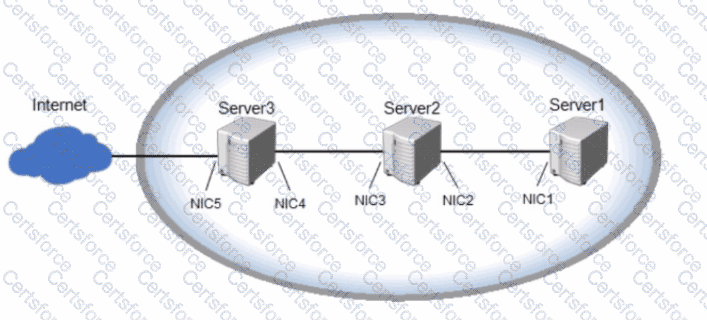
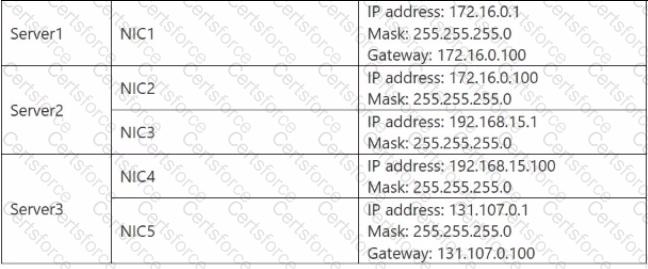
Server3 is configured as a NAT gateway. All the servers allow ICMP requests.
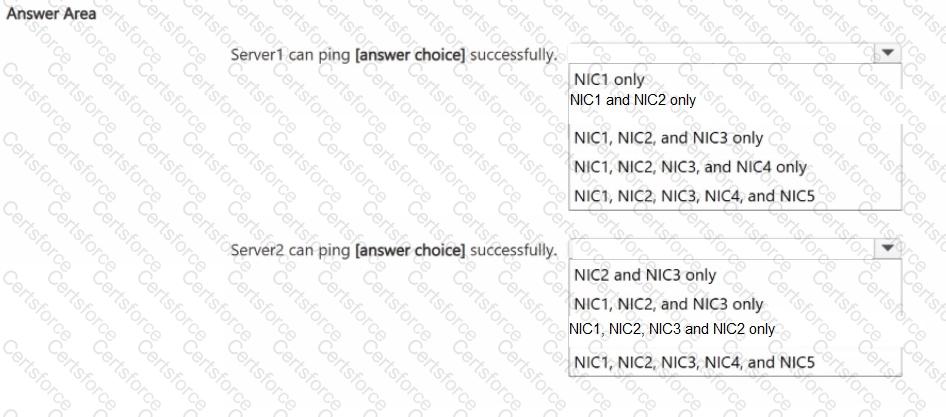
Use the drop-down menus to select the answer choice that completes each statement based on the information presented in the graphic.
NOTE: Each correct selection is worth one point.
Note: This question is part of a series of questions that present the same scenario. Each question in the series contains a unique solution that might meet the stated goals. Some question sets might have more than one correct solution, while others might not have a correct solution.
After you answer a question in this section, you will NOT be able to return to it. As a result, these questions will not appear in the review screen.
You have a failover cluster named Cluster! that hosts an application named Appl.
The General tab in App1 Properties is shown in the General exhibit (Click the General tab.)
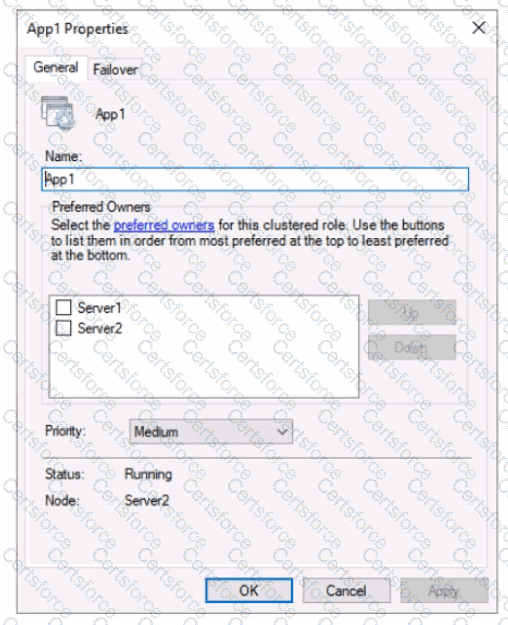
The Failover tab in App1 Properties is shown in the Failover exhibit. (Click the Failover tab.)
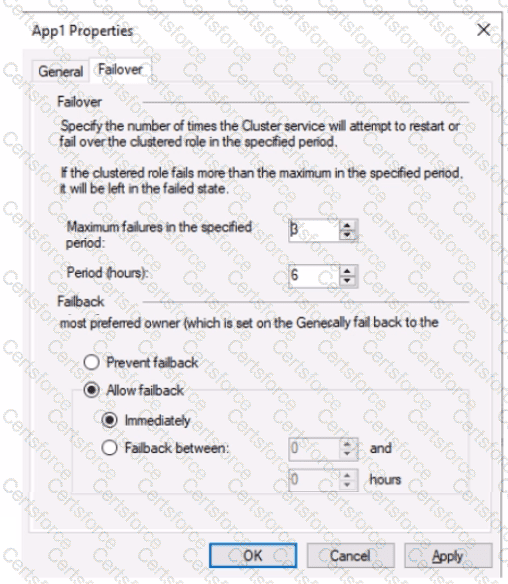
Server2 shuts down unexpectedly.
You need to ensure that when you start Server2, App1 continues to run on Server2.
Solution: You pause the Server1 node in Cluster1 and then start Server1.
Does this meet the goal?
Your network contains an Active Directory Domain Services (AD DS) forest. The forest contains a user named User1. You deploy a read-only domain controller (RODC) named RODC1.
You need to ensure that User1 is a local administrator on RODC1. The solution must use the principle of least privilege. What should you use?
You have the resources shown in the following table.
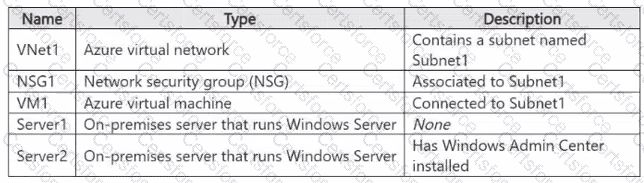
Your on-premises network is connected to VNet1 by using a Site-to-Site VPN. The network traffic sent from Server1 fails to reach VM1.
You need to review the contents of the network traffic sent from Server1 to VM1. What should you do first?
You have a server named Server1 that runs Windows Server.
On Server1, you create a Data Collector Set named CollectorSet1 based on the Basic template.
You need to configure CollectorSet1 to meet the following requirements:
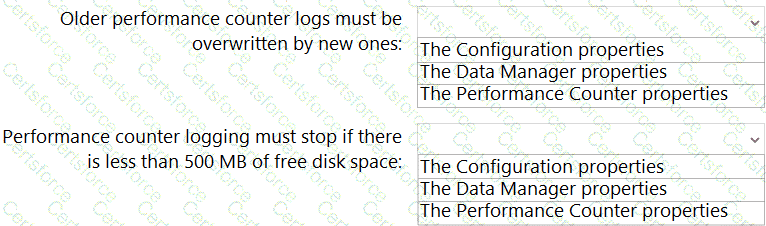
Older performance counter logs must be overwritten by new ones.
Performance counter logging must stop if there is less than 500 MB of free disk space.
What should you configure for each requirement? To answer, select the appropriate options in the answer area.
NOTE: Each correct selection is worth one point.
Your on-premises network contains two subnets. The subnets contain servers that run Windows Server as shown in the following table.
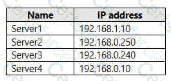
Server4 has the following IP configurations:
Ethernet adapter Ethernet:
Connection-specific DNS Suffix.:
IPv4 Address . . . . . . . . . . . : 192.168.0.10
Subnet Mask . . . . . . . . . . . : 255.255.255.0
Default Gateway . . . . . . . . . : 192.168.0.1
From Server4, you can ping Server1 and Server2 successfully. When you ping Server3, you get a Request timed out response.
From Server2, you can ping Server1 and Server3 successfully.
The misconfiguration of which component on Server3 can cause the Request timed out response?