
What command would have created the token displayed below?
$ vault token lookup hvs.nNeZ2I64ALCxuO7dqQEJGPrO
Key: policies Value: [default dev], num_uses: 5, ttl: 767h59m49s
Key Value
--- -----
accessor mfvaVMFgOcXHIeqlRasroSOn
creation_time 1604610457
creation_ttl 768h
display_name token
entity_id n/a
expire_time 2024-12-07T16:07:37.7540672-05:00
explicit_max_ttl 0s
id hvs.nNeZ2I64ALCxuO7dqQEJGPrO
issue_time 2024-11-05T16:07:37.7540672-05:00
meta < nil >
num_uses 5
orphan false
path auth/token/create
policies [default dev]
renewable true
ttl 767h59m49s
type service
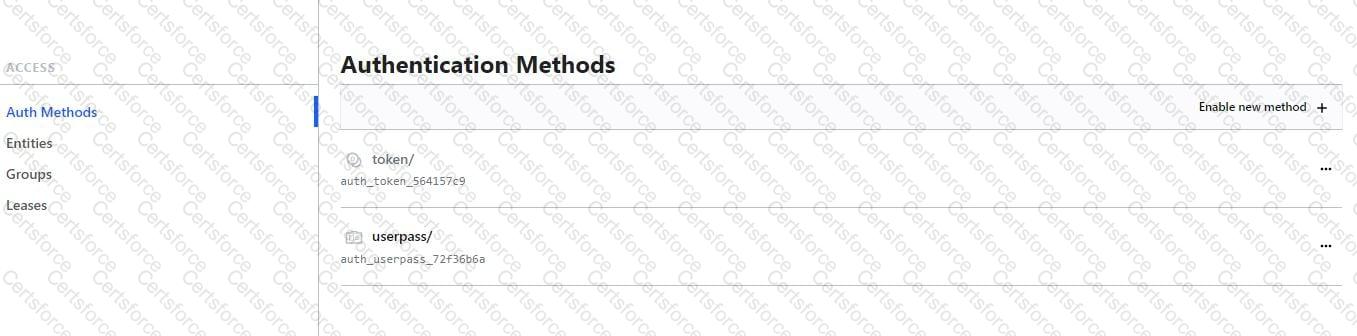
Based on the screenshot below, how many auth methods have been enabled on this Vault instance?
What is true about the output of the following command (select three)?
During a service outage, you must ensure all current tokens and leases are copied to another Vault cluster for failover so applications don’t need to authenticate. How can you accomplish this?
From the options below, select the benefits of using the PKI (x.509 certificates) secrets engine (select three):
What is the default maximum time-to-live (TTL) for a token, measured in days?
True or False? When encrypting data with the Transit secrets engine, Vault always stores the ciphertext in a dedicated KV store along with the associated encryption key.
If Bobby is currently assigned the following policy, what additional policy can be added to ensure Bobby cannot access the data stored at secret/apps/confidential but still read all other secrets?
path " secret/apps/* " { capabilities = [ " create " , " read " , " update " , " delete " , " list " ] }
True or False? Once you create a KV v1 secrets engine and place data in it, there is no way to modify the mount to include the features of a KV v2 secrets engine.
True or False? The Vault Secrets Operator does NOT encrypt client cache, such as Vault tokens and leases, by default in Kubernetes Secrets.
