The correct answer is B .
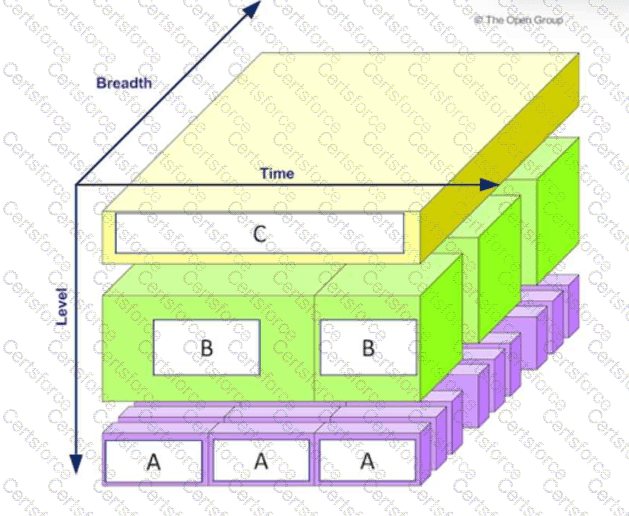
The diagram represents the TOGAF Architecture Landscape classification model. TOGAF 9.2 divides the Architecture Landscape into three levels of granularity: Strategic Architectures , Segment Architectures , and Capability Architectures . In the diagram, the top layer labelled C represents the broad, long-term enterprise-level view, which corresponds to Strategic Architecture . The middle layer labelled B represents more detailed operating models for areas within the enterprise, which corresponds to Segment Architecture . The bottom layer labelled A represents the most detailed level, focused on particular units of capability, work packages, projects, or capability increments, which corresponds to Capability Architecture .
Option A is incorrect because TOGAF 9.2 does not classify the Architecture Landscape using “Operational Architecture”, “Tactical Architecture”, and “Strategy Architecture” as the three official levels.
Option B is correct because it maps the labels properly: A = Capability Architecture , B = Segment Architecture , and C = Enterprise Strategic Architecture . TOGAF 9.2 describes Strategic Architectures as long-term summary views of the entire enterprise, Segment Architectures as more detailed operating models for areas within the enterprise, and Capability Architectures as more detailed descriptions of how the enterprise supports a particular unit of capability.
Option C is incorrect because “Corporate Capability”, “Portfolio Capability”, and “Project Capability” are not the official TOGAF 9.2 Architecture Landscape levels.
Option D is incorrect because Architecture Vision, Business Architecture, and Architecture Development refer to ADM-related concepts and phases, not the Architecture Landscape classification levels.
[References:TOGAF Standard, Version 9.2, Part V: Enterprise Continuum and Tools, Chapter 37: Architecture Repository, Section 37.2: Architecture Landscape.]


Submit