In the framework of a Salesforce Platform Integration Architect's landscape evaluation, the primary goal is to determine the "system of record" for each business function and identify redundancies between legacy systems and the proposed Salesforce architecture. This process is driven by the alignment of Salesforce's native "Customer 360" capabilities with the specific goals defined by the enterprise stakeholders.
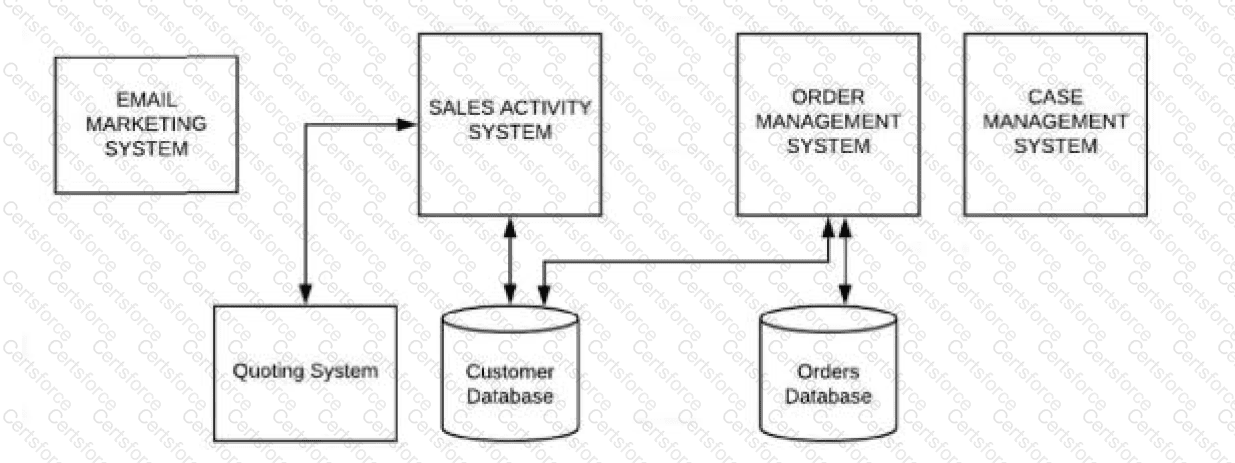
According to Goal 2, the customer intends to leverage Salesforce specifically for marketing, sales, and service processes. Within the standard Salesforce ecosystem, these domains are addressed by the three core cloud products:
Marketing Cloud provides the capabilities found in the legacy Email Marketing System.
Sales Cloud replaces the functions of the Sales Activity System.
Service Cloud is the native replacement for the Case Management System.
By migrating these three domains to a single platform, the organization directly fulfills Goal 1—developing a 360-degree view of the customer. Consolidating these interactions onto the Salesforce platform allows for a unified data model where customer behaviors in marketing, sales, and support are visible in one place, eliminating the silos inherent in the previous landscape.
However, a critical constraint is presented in Goal 3, which explicitly mandates the reuse of existing enterprise capabilities for quoting and order management. In an integration architecture, this signals that the Quoting System and Order Management System (OMS) are designated as external systems of record that must remain active. These systems often contain complex logic, tax calculations, or supply chain integrations (such as with an SAP Business Suite) that the business is not currently ready to migrate.
Therefore, since the Quoting and Order Management systems must be retained, they are excluded from the retirement list. The remaining three systems—Email Marketing, Sales Activity, and Case Management—overlap with Salesforce's native strengths and are not protected by the "reuse" requirement. Retiring them streamlines the technology stack and allows the architect to focus on building robust integration patterns (such as REST or SOAP callouts) to connect Salesforce to the retained Quoting and Order Management systems.


Submit