Resource Reservation Protocol–Traffic Engineering (RSVP-TE) maintains signaling information using a soft-state architecture. PATH and RESV messages periodically refresh the corresponding state along an established Label Switched Path.
When the applicable refresh messages are no longer received, established RSVP state eventually expires.
A PathTear message explicitly removes path state and associated dependent reservation state. It travels downstream toward the receiver of the LSP.
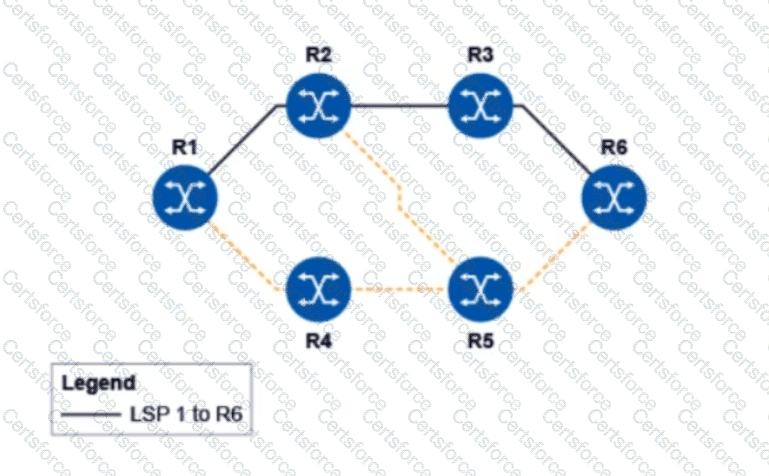
The illustrated LSP follows the path:
R1 → R2 → R3 → R6.
When path state expires at R3, the router initiates PathTear processing in the downstream direction toward R6.
A PathErr message operates differently. It reports errors encountered during PATH message processing and normally travels upstream toward the originating sender. It does not serve as the explicit path-state teardown mechanism.
Reservation-state expiration uses the corresponding ResvTear mechanism, which travels upstream.
Since the available options concern PATH-related messages, option A correctly identifies the teardown action associated with expired path state at R3.
[Reference:Nokia SR OS MPLS Guide — RSVP State Maintenance; RFC 2205, Section 2.4 — Teardown Messages., Technical clarification:The question should explicitly state that PATH state has expired. Generic RSVP session-state expiration does not distinguish between PATH and RESV state.]


Submit