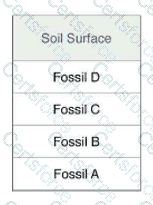
This question tests understanding of the law of superposition, a fundamental principle in geology that is frequently tested on the NEX Science exam. The law of superposition states that in undisturbed sedimentary rock layers, the oldest layers are found at the bottom, while the youngest layers are found at the top. In the table shown, the soil surface is at the top, followed by Fossil D, Fossil C, Fossil B, and Fossil A at the bottom. Because Fossil A is located in the lowest rock layer, it must be the oldest fossil. Fossils found in higher layers were deposited more recently. The key word in the question is “undisturbed,” which means the layers have not been mixed or overturned by geological processes. The NEX exam often emphasizes recognizing this clue to correctly apply the law of superposition. Therefore, Fossil A is the correct answer because it represents the earliest life form preserved in the rock strata.
Contribute your Thoughts:
Chosen Answer:
This is a voting comment (?). You can switch to a simple comment. It is better to Upvote an existing comment if you don't have anything to add.


Submit