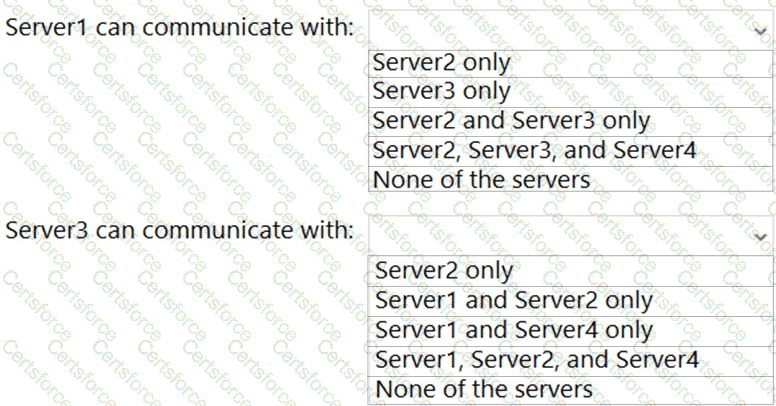
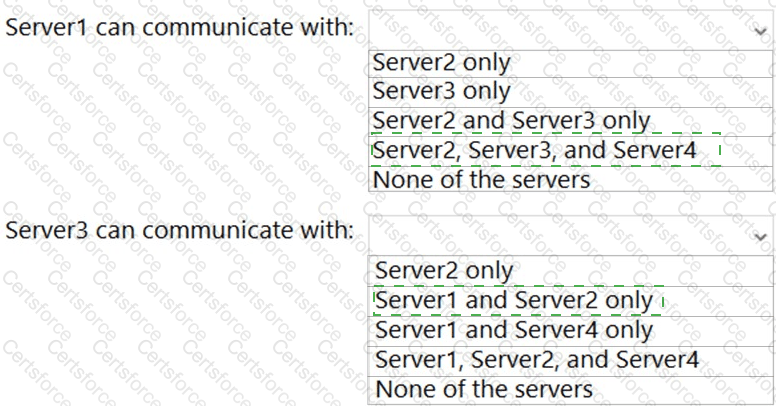
Server1 can communicate with: Server2, Server3, and Server4. Server3 can communicate with: Server1 and Server2 only.
Server4 has no isolation connection security rule configured at all, so it never attempts or performs IPsec authentication with any peer. Server1 ' s rule only requests IPsec in both directions rather than requiring it, meaning that if IPsec negotiation does not occur -- as with Server4, which has no IPsec capability configured -- the connection still falls back to succeed in the clear; Server1 can therefore reach Server2, Server3, and Server4. Server3 ' s rule requires IPsec in both directions, meaning a connection only succeeds if IPsec authentication is actually negotiated. Server3 can successfully negotiate IPsec with Server1 (whose " request " setting means it will still respond to and complete an IPsec negotiation when the peer requires it) and with Server2 (which requires inbound and requests outbound IPsec, and likewise supports negotiation), so both of those connections succeed. Server3 cannot successfully negotiate IPsec with Server4, since Server4 has no IPsec capability configured at all, and Server3 ' s " require " setting blocks any connection that cannot be authenticated via IPsec. Therefore, Server1 can communicate with Server2, Server3, and Server4, while Server3 can communicate with only Server1 and Server2.
Contribute your Thoughts:
Chosen Answer:
This is a voting comment (?). You can switch to a simple comment. It is better to Upvote an existing comment if you don't have anything to add.


Submit