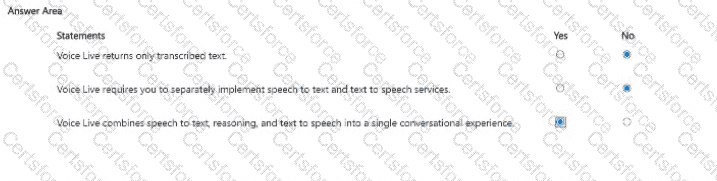
Statement 1: Voice Live returns only transcribed text. = No
Voice Live is not limited to transcription. Microsoft documentation states that the Voice Live API supports real-time bidirectional voice applications, including speech recognition, text-to-speech synthesis, avatar streaming, animation data, and audio processing.
Statement 2: Voice Live requires you to separately implement speech to text and text to speech services. = No
Voice Live provides a single real-time voice API experience rather than requiring separate STT and TTS implementations for the conversational loop. Microsoft describes live AI voice conversations as combining speech capabilities for real-time interaction, and the Voice Live API includes speech recognition and text-to-speech synthesis features.
Statement 3: Voice Live combines speech to text, reasoning, and text to speech into a single conversational experience. = Yes
This is correct. Microsoft’s guidance explains that Azure OpenAI audio/realtime capabilities are for scenarios that combine audio with language understanding, reasoning, or generation in a single model call, and Voice Live supports real-time voice-enabled applications over WebSocket connections.


Submit