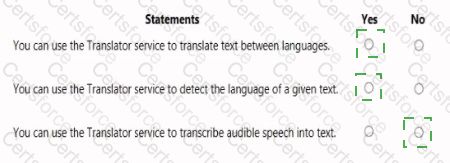
Yes, Yes, and No.
According to the Microsoft Azure AI Fundamentals (AI-900) official study materials and the Microsoft Learn module “Identify features of natural language processing (NLP) workloads on Azure”, the Azure Translator service is a cloud-based AI service within Azure Cognitive Services that provides real-time text translation across multiple languages.
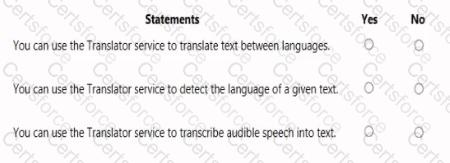
“You can use the Translator service to translate text between languages.” – Yes.This is the core function of the Translator service. It takes text as input in one language and returns it in another using advanced neural machine translation models. This aligns with the AI-900 learning objective: “Describe the capabilities of Azure Cognitive Services for language”, which specifically names Azure Translator as the service used to perform automatic text translation. The service supports over 100 languages and dialects, offering both single-sentence and document-level translations.
“You can use the Translator service to detect the language of a given text.” – Yes.This statement is also true. The Translator service automatically detects the source language if it is not specified in the request. This feature is documented in the Azure Translator API, where the system identifies the input language before performing translation. The AI-900 exam content emphasizes this as one of the Translator service’s built-in capabilities—language detection for untagged text.
“You can use the Translator service to transcribe audible speech into text.” – No.This is not a function of Translator. Transcription (converting speech to text) is a speech AI workload, handled by the Azure Speech Service, not Translator. The Speech-to-Text capability in Azure Cognitive Services processes spoken audio input and returns the text transcription. The Translator service only works with text input, not direct audio.
Therefore, based on official AI-900 guidance, the verified configuration is:
✅ Yes – for text translation
✅ Yes – for language detection
❌ No – for speech transcription.
This aligns precisely with the AI-900 learning outcomes describing Text Translation and Language Detection as Translator capabilities, and Speech Transcription as part of the separate Speech service.


Submit