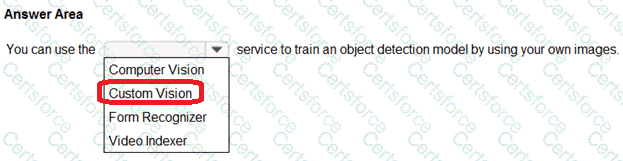
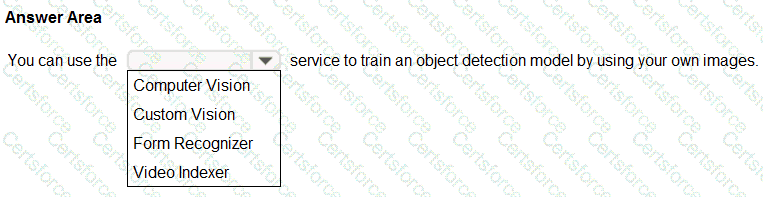
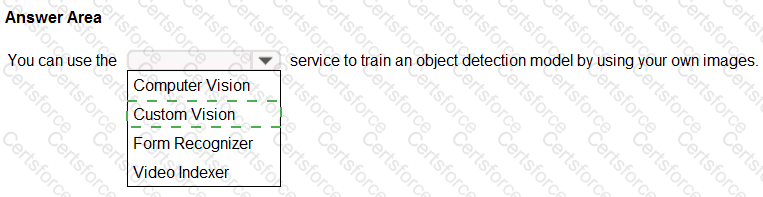
Azure Custom Vision is a cognitive service that lets you build, deploy, and improve your own image classifiers. An image classifier is an AI service that applies labels (which represent classes) to images, according to their visual characteristics. Unlike the Computer Vision service, Custom Vision allows you to specify the labels to apply.
Note: The Custom Vision service uses a machine learning algorithm to apply labels to images. You, the developer, must submit groups of images that feature and lack the characteristics in question. You label the images yourself at the time of submission. Then the algorithm trains to this data and calculates its own accuracy by testing itself on those same images. Once the algorithm is trained, you can test, retrain, and eventually use it to classify new images according to the needs of your app. You can also export the model itself for offline use.
[Reference:, https://docs.microsoft.com/en-us/azure/cognitive-services/custom-vision-service/home, , custom vision - This is a type of computer vision service which helps in building/training models using user provided data, Creating an object detection solution with Custom Vision consists of three main tasks. First you must use upload and tag images, then you can train the model, and finally you must publish the model so that client applications can use it to generate predictions., https://docs.microsoft.com/en-us/learn/modules/detect-objects-images-custom-vision/2-object-detection-azure, , , , , ]


Submit