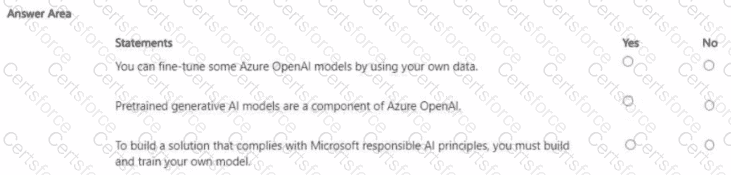
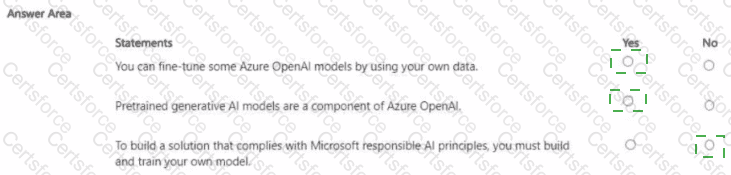
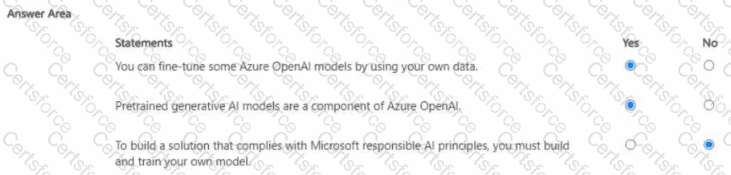
“You can fine-tune some Azure OpenAI models by using your own data.” – YESThis statement is true. Azure OpenAI allows customers to fine-tune certain models like GPT-3, GPT-3.5, and some embedding models with their own data. Fine-tuning customizes a model to perform better on specific tasks or match a company’s domain terminology, tone, or context. According to Microsoft Learn’s AI-900 and Azure OpenAI documentation, fine-tuning is supported for approved use cases while maintaining Microsoft’s Responsible AI oversight and compliance process.
“Pretrained generative AI models are a component of Azure OpenAI.” – YESThis statement is also true. Azure OpenAI provides access to pretrained large language and generative AI models such as GPT-3.5, GPT-4, Codex, and DALL·E. These models are pretrained on vast datasets and made available via APIs, allowing developers to generate text, code, and images without needing to train their own models. This is a core feature of Azure OpenAI’s service offering.
“To build a solution that complies with Microsoft responsible AI principles, you must build and train your own model.” – NOThis statement is false. Compliance with Microsoft Responsible AI principles (Fairness, Reliability & Safety, Privacy & Security, Inclusiveness, Transparency, Accountability) does not require building custom models. Prebuilt Azure AI and OpenAI services already align with Responsible AI standards. Developers simply need to use these services responsibly, applying governance and ethical design practices.
Contribute your Thoughts:
Chosen Answer:
This is a voting comment (?). You can switch to a simple comment. It is better to Upvote an existing comment if you don't have anything to add.


Submit