The Azure Text Analytics service, a component of Azure Cognitive Services, provides natural language processing (NLP) capabilities to analyze and understand text-based data. According to the Microsoft Azure AI Fundamentals (AI-900) official study guide and Microsoft Learn module “Identify features and uses for Natural Language Processing (NLP)”, the Text Analytics service supports multiple text understanding tasks, such as language detection, key phrase extraction, sentiment analysis, and entity recognition.
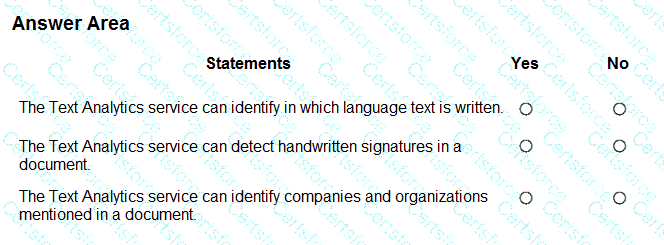
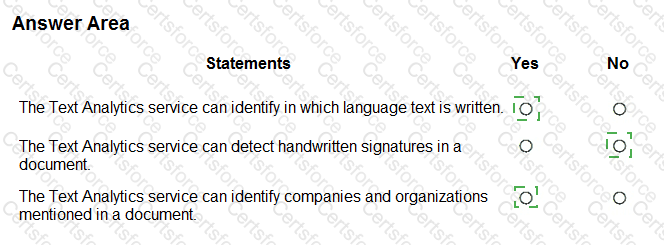
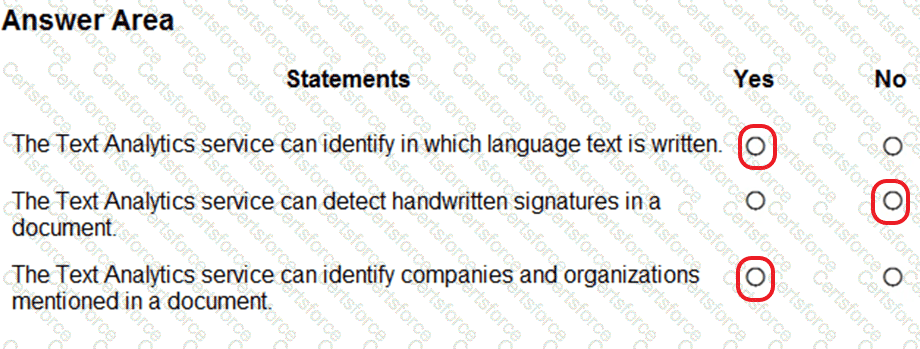
Language Identification – Yes:Text Analytics can automatically detect the language in which text is written. This feature analyzes linguistic patterns and assigns a language code (for example, “en” for English, “es” for Spanish). It is one of the primary features described in Microsoft Learn as part of the service’s Language Detection API.
Detect Handwritten Signatures – No:Detecting handwritten signatures is not a text-based NLP task. Instead, it belongs to the computer vision domain, specifically Optical Character Recognition (OCR). The Text Analytics service only processes digital text, not handwritten or image-based data. To detect handwriting or signatures, you would use the Computer Vision OCR API, not Text Analytics.
Entity Recognition – Yes:The Text Analytics service can identify named entities—such as people, locations, organizations, dates, and quantities—within documents. This is known as Named Entity Recognition (NER), which helps extract structured information from unstructured text.
Contribute your Thoughts:
Chosen Answer:
This is a voting comment (?). You can switch to a simple comment. It is better to Upvote an existing comment if you don't have anything to add.


Submit