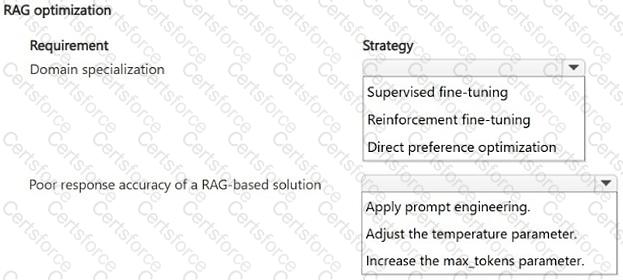
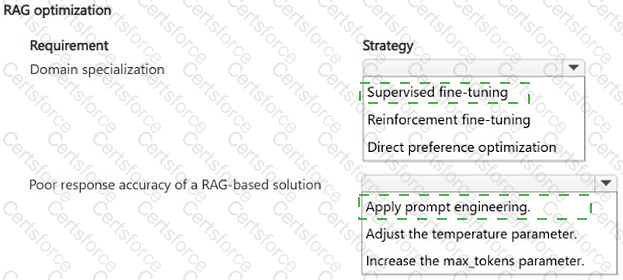
Domain specialization: Supervised fine-tuning
Poor response accuracy of a RAG-based solution: Apply prompt engineering
For domain specialization , Supervised Fine-Tuning (SFT) is the correct first strategy. Microsoft describes SFT as the foundational fine-tuning technique for training a model from labeled input-output pairs , and specifically identifies domain specialization as one of its principal use cases. Microsoft also recommends starting with SFT for most customization projects because it supports task specialization, instruction following, style, and domain-specific behavior. Fabrikam already possesses evaluation data containing input-output pairs, which aligns directly with the SFT data model.
For poor RAG response accuracy , the first action is prompt engineering . The case explicitly requires advanced fine-tuning only when prompt engineering is insufficient. In a RAG system, prompt engineering determines how the model interprets retrieved context, constrains answers to grounding information, handles missing evidence, and formats responses. Microsoft notes that inadequate RAG prompting can produce false or incomplete answers even when retrieval returns appropriate content.
DPO is primarily appropriate for alignment using preferred versus non-preferred responses, while RFT targets complex reward-based reasoning optimization. Neither is the initial technique for domain specialization in this requirement.
Study Guide Reference: Optimize generative AI systems and model performance — prompt engineering, RAG optimization, supervised fine-tuning, preference optimization, and model customization strategy.


Submit