
The question maps directly to the AI-200 objective “Develop AI solutions by using Azure Cosmos DB for NoSQL,” which includes running queries and optimizing query performance and Request Unit (RU) consumption.
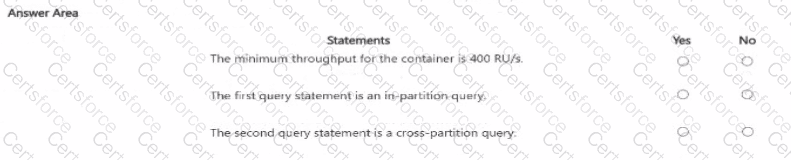
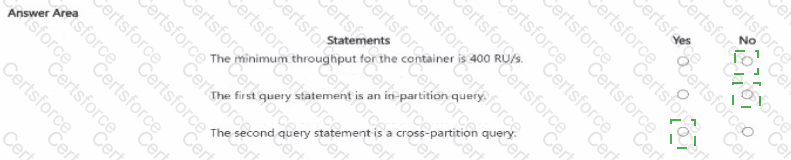
Statement 1: No — The minimum throughput is not 400 RU/s.
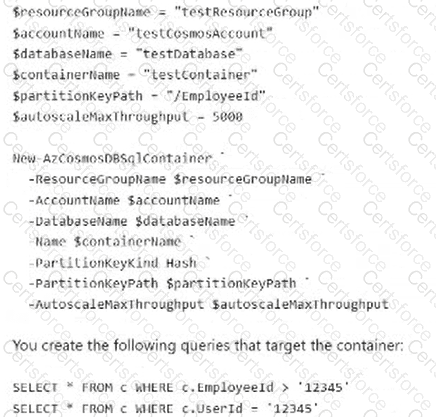
The PowerShell command provisions the container with:
-AutoscaleMaxThroughput 5000
Azure Cosmos DB autoscale operates between approximately 10% and 100% of the configured maximum throughput . Microsoft documentation specifically gives the example of an autoscale container provisioned with 5,000 RU/s scaling between 500 RU/s and 5,000 RU/s . Therefore, for this container, the minimum operating autoscale throughput is 500 RU/s , not 400 RU/s.
Therefore:
“The minimum throughput for the container is 400 RU/s.” → No
Statement 2: No — The first query is not an in-partition query.
The container uses:
/EmployeeId
as its partition key.
The first query is:
SELECT * FROM c WHERE c.EmployeeId > ' 12345 '
Although the query references the partition key, it uses a range predicate ( > ) , not an equality predicate. Microsoft explicitly states that a range filter on a partition key is not scoped to a single physical partition . To qualify as an in-partition query, the filter must identify the applicable partition, typically through an equality predicate such as:
WHERE c.EmployeeId = ' 12345 '
Microsoft ' s documentation provides essentially the same example: a query using DeviceId > ... against a container partitioned by DeviceId is not an in-partition query .
Therefore:
“The first query statement is an in-partition query.” → No
Statement 3: Yes — The second query is a cross-partition query.
The second query is:
SELECT * FROM c WHERE c.UserId = ' 12345 '
The container ' s partition key is /EmployeeId, not /UserId. Because the query contains no filter on the partition key , Azure Cosmos DB cannot route it to one logical partition. It must fan out the query across the applicable physical partitions and combine the results.
Microsoft describes this behavior directly: when a query does not contain a filter on the partition key, it must execute across the partitions.
Therefore:
“The second query statement is a cross-partition query.” → Yes


Submit