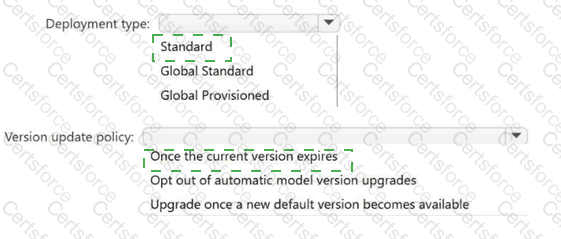
Version update policy: Once the current version expires
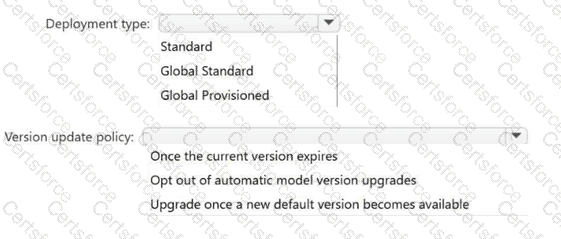
The correct deployment type is Standard . The case study specifies that Project1 is deployed in an EU Azure region and that model-processed data must remain within the EU. It also requires scalable, high-throughput generative AI workloads that dynamically handle variable customer support traffic without reserved throughput capacity. In Microsoft Foundry Models, Standard is a pay-per-token deployment type that processes data in a single Azure region, while Global Standard can process requests across regions and Global Provisioned uses reserved provisioned throughput. Microsoft’s deployment-type guidance identifies Standard as single-region, pay-per-token, whereas Global Provisioned is cross-region with reserved capacity.
The correct version update policy is Once the current version expires . This keeps Agent1 on the selected model version during its supported lifecycle, which supports stable and consistent responses, but still preserves continuity by automatically moving to a supported replacement when the current version is retired. Microsoft’s model versioning guidance states that this policy updates only when the current model version expires, while upgrading when a new default is available changes the deployment sooner and opting out can cause the deployment to stop working after retirement. Reference topics: deployment types, regional data processing, model versioning, throughput capacity, and stable production deployments.
Contribute your Thoughts:
Chosen Answer:
This is a voting comment (?). You can switch to a simple comment. It is better to Upvote an existing comment if you don't have anything to add.


Submit